
What 'Best Rated' Really Means for Denver Metro Homes
When people ask which replacement windows are rated the best, they usually mean which brand wins some kind of contest. The honest answer is that there is no single winner because the right rating depends on which direction a window faces, how old the house is, and what kind of winters and summers it has to survive. In the Denver Metro, that means cold, dry winters with intense winter sun, hot summer afternoons, and big daily temperature swings that stress seals and frames more than a milder climate would.
So instead of chasing a brand name, the smarter move is learning to read the actual performance numbers printed on every certified window. Those numbers come from an independent testing program, not a marketing department, and they let you compare a $300 window against a $900 window on the same terms. Once you understand three or four core ratings, you can judge any window on the lot, whether it is vinyl, fiberglass, or wood-clad.
How Window Ratings Actually Work
Every window sold with an energy rating in the US goes through testing from the National Fenestration Rating Council, commonly shortened to NFRC. That organization doesn't sell windows, it just tests them and publishes a sticker with a handful of standardized numbers so a shopper can compare products side by side regardless of brand.
The NFRC Label
The NFRC sticker reports several figures, but the two that matter most for a home are U-factor and solar heat gain coefficient, or SHGC. U-factor measures how well the window keeps heat from escaping, and lower numbers mean better insulation. SHGC measures how much solar heat passes through the glass, and the right number here actually depends on which way the window faces.
The label also lists visible transmittance, which tells you how much natural light gets through, and air leakage, which measures how much outside air sneaks past the frame and sash. A window with a great U-factor but poor air leakage can still feel drafty, so it's worth checking both rather than fixating on just one number.
Energy Star vs NFRC
Energy Star certification builds on top of NFRC testing rather than replacing it. The federal program sets minimum U-factor and SHGC thresholds for different climate zones, and a window either clears that bar for your zone or it doesn't. Colorado falls in the Northern climate zone for this program, which calls for a lower U-factor than what's required in a southern state.
That means a window can carry an Energy Star label in Colorado with a different, tighter U-factor than the same window would need to carry that label in Arizona. It's a useful quick filter when you're comparing options, but it's a pass or fail stamp, not a ranking, so two Energy Star windows can still have meaningfully different performance once you look at the underlying NFRC numbers.
| Rating | What It Measures | What to Look For in Colorado |
|---|---|---|
| U-factor | How much heat escapes through the window | Lower number, generally 0.20 to 0.30 |
| SHGC | How much solar heat passes through the glass | Higher on south-facing glass, lower on west-facing glass |
| Air Leakage | How much outside air passes the frame and sash | Lower number, tighter seal around the opening |
| Visible Transmittance | How much daylight comes through | Higher if you want more natural light indoors |
The Parts of a Window That Drive Its Rating
The rating sticker is really a summary of what's happening inside the window itself. The glass package does most of the heavy lifting, and options like double or triple panes, low-E coatings, and gas fills between the panes all shift the U-factor and SHGC numbers up or down. A window with two panes of glass and a low-E coating will usually out-perform a plain double pane window from the same product line.
Frame material and the spacer that separates the panes of glass matter too. Vinyl and fiberglass frames tend to insulate better than aluminum, and a warm-edge spacer system cuts down on condensation and heat transfer at the edge of the glass, which is often the weakest point in an older window. When we handle window replacement for a home, the glass package and frame material are the two decisions that move the rating the most.
Step-by-step: How to Compare Window Ratings Before You Buy
You don't need an engineering degree to shop by the numbers. Walking through the same checklist for every window on your list keeps the comparison fair and catches the details a showroom display won't point out on its own.
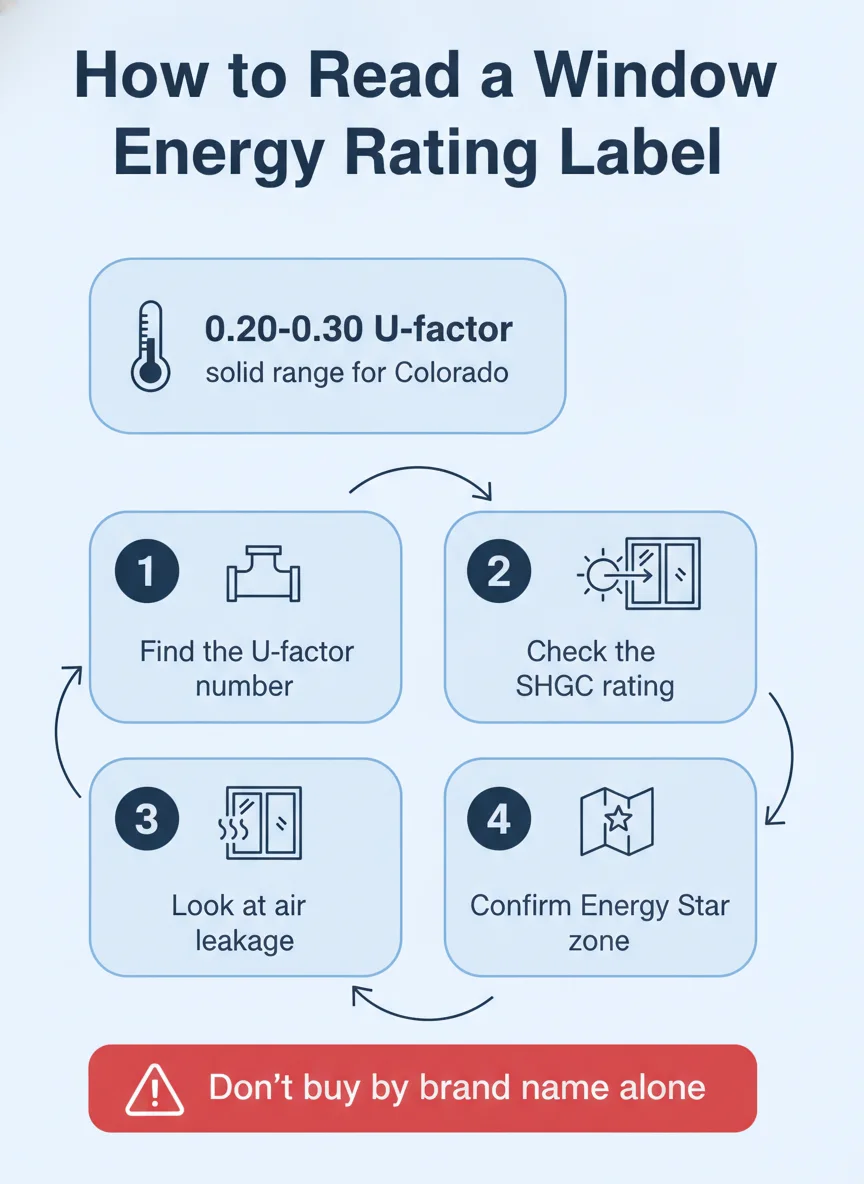
- Pull the NFRC sticker: Ask for the actual NFRC label for the exact glass package and frame you're considering, not a generic brand brochure number.
- Check the U-factor: Compare U-factor across every window on your list first, since it drives most of the winter heating performance in Colorado.
- Match SHGC to orientation: Note which direction each window will face in your home and look for a higher SHGC on south walls and a lower one on west walls.
- Review air leakage: A tight air leakage number matters as much as glass performance, especially on older openings that have shifted over time.
- Confirm Energy Star status: Make sure the window clears the Northern climate zone threshold if an Energy Star label matters to you.
- Ask about the frame: Find out what the frame is made of and what kind of spacer sits between the panes, since both affect the final rating.
- Get it in writing: Have the rating numbers written into your quote so you can hold the installer to the window you actually agreed to.
What the Ratings Tell You About Different Window Types
Double-Hung and Sliding Windows
Double-hung and sliding windows have moving sashes that meet at a seam, which gives air a path to sneak through if the weatherstripping isn't tight. Because of that extra seam, these styles sometimes show a slightly higher air leakage number than a fixed window of the same glass package, even when the U-factor and SHGC are identical.
That's not a reason to avoid them. These are the most common window styles for Colorado homes because they balance ventilation and ease of cleaning, and a well-built double-hung or slider from a quality manufacturer still performs well against the ratings that matter most for comfort and energy use.
Casement and Awning Windows
Casement and awning windows crank open and seal by pressing the sash against the frame like a refrigerator door, which generally gives them a tighter air leakage rating than a slider or double-hung. That design advantage shows up on the label and can make a real difference on a wall that takes a lot of wind.
The tradeoff is less flexibility in sizing and a different look than a traditional double-hung window. For a home where energy performance on a specific exposed wall is the priority, the air leakage numbers on a casement often make it worth the different operation style.
DIY vs Calling a Pro: Reading Labels vs Choosing the Right Window
Reading an NFRC sticker and comparing the numbers across a few product lines is something any homeowner can do with a little patience. Most manufacturer websites publish their rating tables, and a showroom should hand you the actual label, not just a glossy brochure, when you ask.
Where it gets harder to go it alone is matching those numbers to your specific house. Deciding how much SHGC you want on a west-facing wall that gets brutal afternoon sun, or whether a slightly higher U-factor is worth it for a wider glass area, takes some back and forth with someone who measures openings and installs windows for a living.
That's also where brand and installation quality start to matter as much as the rating sticker. A great rated window installed with a poor seal around the opening will still leak air, and the reverse is true too, a mid-range window installed tight can outperform its own numbers. If you'd rather talk through options for your home than compare spec sheets alone, give us a call and we'll walk the openings with you.
Choosing Ratings That Fit Your House, Not Just the Chart
The best rated replacement window for a home in Highlands Ranch facing a west sun exposure isn't necessarily the best rated window for a shaded north wall in Wheat Ridge. Use the NFRC numbers as your baseline, lean toward Energy Star certification for the Northern climate zone, and then adjust SHGC and U-factor by orientation rather than treating every opening in the house the same.
If you want help pulling it all together, a lot of homeowners start by reading up on what replacement window actually fits a Colorado home before narrowing down brands and glass packages. Precise Windows LLC can walk your home's openings, go over the rating numbers for each option, and help you land on a window that earns its sticker on your actual walls, not just on paper.
Frequently asked questions
What is a good U-factor for windows in Colorado?
A lower U-factor holds heat inside better, and most homes along the Front Range do well with something in the 0.20 to 0.30 range. The right number for your house depends on how many windows face north and how much of your heating bill comes from window loss versus wall or attic loss.
Is Energy Star the same thing as the NFRC rating?
No, they work together but measure different things. The NFRC label reports the raw performance numbers like U-factor and solar heat gain, while Energy Star is a pass or fail certification built on top of those numbers for a given climate zone.
Do more expensive window brands always score higher ratings?
Not automatically. Rating numbers come from the glass package, the frame material, and the spacer system, so a mid-tier line with a strong glass upgrade can out-rate a premium line with its base glass package.
Does SHGC matter if my house gets a lot of winter sun?
Yes, and it can work in your favor. A higher solar heat gain coefficient on south-facing windows lets in free winter warmth, while a lower SHGC on west-facing windows cuts down on summer afternoon heat.
Can I trust the rating sticker that comes with a window?
Yes, NFRC-certified labels are tested by an independent program rather than self-reported by the manufacturer. Just make sure the sticker reflects the exact glass package and frame you're buying, since the same window line can carry different ratings depending on the options you choose.