
Why Vinyl Window Lifespan Looks Different Here Than in Other States
Vinyl replacement windows are one of the most common upgrades homeowners make across the Denver metro, and for good reason. They're affordable, they don't need repainting, and they hold up to weather that would wear down a wood frame in half the time. But Colorado throws a specific combination of stress at vinyl that a lot of national lifespan estimates don't account for: intense high-altitude sun, hard freezes overnight, and wide daily swings between the two.
That combination means two homes with the same vinyl window brand, installed the same year, can age at different rates depending on which direction the window faces and how well it was sealed into the opening. A window on the shady north side of a house in Littleton or Wheat Ridge will often outlast an identical one baking on a south-facing wall in Aurora or Centennial. Understanding what's actually driving wear helps you plan ahead instead of guessing at replacement timing.
What Actually Wears Vinyl Down Over Time
Vinyl itself is a stable, weather-resistant material, but it's not indestructible. Two things do most of the damage over a window's life: ultraviolet light breaking down the surface of the vinyl, and repeated expansion and contraction as temperatures swing from a 70-degree afternoon to a 20-degree night. Neither happens overnight, but both add up year after year.
UV Exposure and Sun-Facing Walls
Colorado sits at a higher altitude than most of the country, which means more direct UV reaching every surface, including window frames. Over a couple decades, that UV exposure is what causes the chalky, faded look some older vinyl frames develop, especially on south- and west-facing walls that catch afternoon sun directly.
The glass itself usually holds up fine under UV, it's the vinyl frame and the seals around the glass that take the brunt of it. A window with a lower-quality seal can start to let moisture in between the panes years before the frame itself shows any visible wear, which is why fogging glass is often the first sign something's going.
Temperature Swings and Seal Stress
Vinyl expands when it heats up and contracts when it cools, and Colorado's daily swings put that cycle into overdrive compared to milder climates. Over thousands of cycles, that constant tiny movement can stress the seals and corners of a window frame, which is part of why installation quality matters so much. A window that was properly flashed and sealed into the opening handles that movement far better than one that wasn't.
This is also why two windows of the same age and brand can perform so differently. The one with a tight, correctly sealed opening keeps doing its job long after a poorly installed twin starts drafting, sticking, or fogging.
| Factor | Shortens Lifespan | Extends Lifespan |
|---|---|---|
| Sun exposure | South/west-facing walls, direct afternoon sun | North-facing or shaded walls |
| Installation quality | Gaps or poor sealing around the opening | Properly sealed, flashed opening |
| Glass seal | Early fogging between panes | Intact seal holding insulating gas |
| Frame care | Dirt and grime left to build up | Occasional cleaning of frame and tracks |
The Parts of a Vinyl Window That Age Differently
A vinyl window isn't one single piece that ages uniformly, it's a system of parts that each wear at their own pace. The frame and sash are the vinyl itself, built to resist weather for decades. The glass unit, especially if it's double- or triple-pane, has a separate seal holding the insulating gas between the panes, and that seal is usually the first thing to fail.
Hardware like locks, hinges, and balance springs are mechanical parts that simply wear out with use over the years, independent of how the vinyl or glass are holding up. That's why a window can have perfectly good vinyl and glass but still need a lock or balance repaired, and it's also why a full inspection looks at all three systems rather than just the frame.
Step-by-Step: Checking Your Vinyl Windows for Wear
A homeowner can check most of this without any tools, just a few minutes walking the house and paying attention to how each window looks and feels.
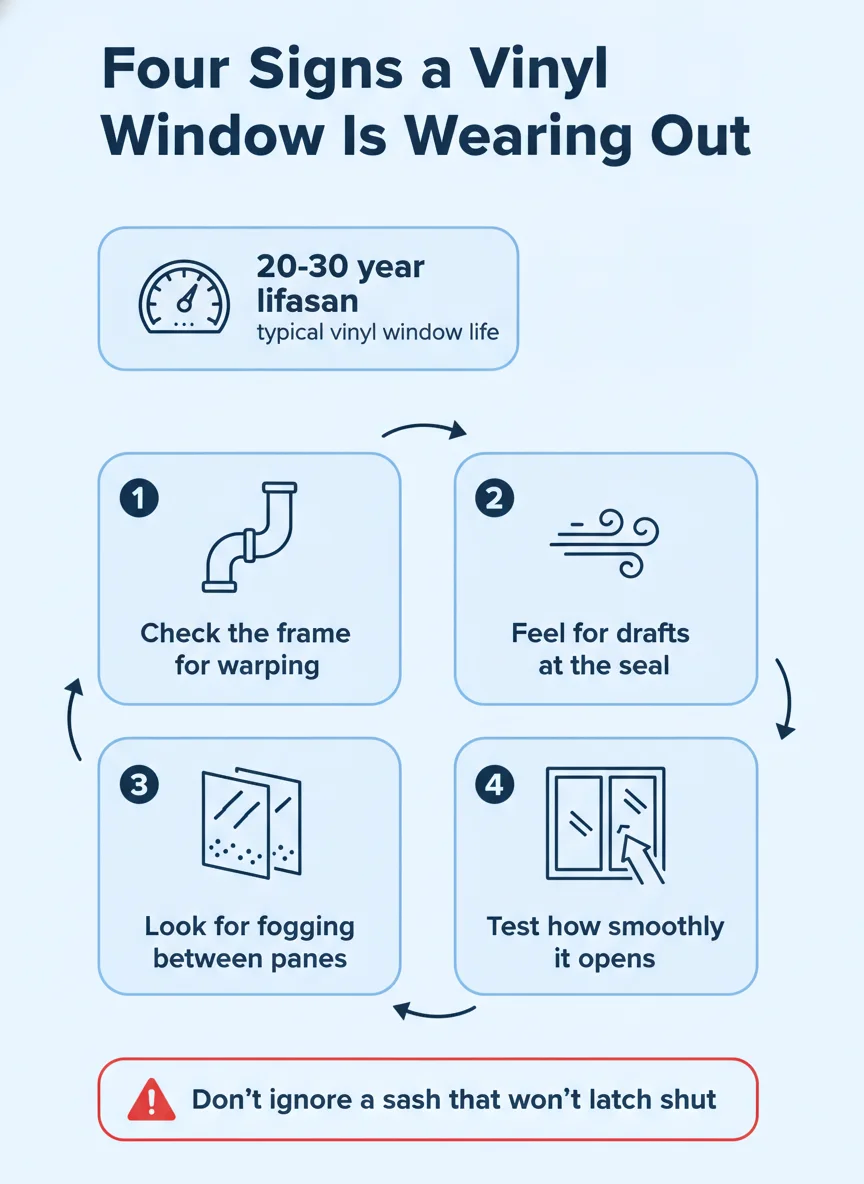
- Look at the frame: Check for warping, cracking, or a chalky, faded surface, especially on windows that get direct afternoon sun.
- Check the corners: Press gently at the corners of the frame to feel for any looseness or separation in the vinyl.
- Feel for drafts: Run a hand along the edge of a closed window on a windy day to check for air movement around the seal.
- Look between the panes: Check for fogging or a hazy film between the glass layers, which signals a failed seal.
- Test the operation: Open and close the window to see if it moves smoothly or catches, sticks, or won't latch all the way.
- Check the locks: Make sure the lock engages fully and the window sits flush when locked, since a gap here lets in air and moisture.
What You'll Find When Vinyl Windows Start to Age
If you've gone through the checklist above and noticed a few issues, it helps to know which ones are minor and which ones mean the window is nearing the end of its useful life.
Minor Issues That Don't Mean Replacement
A sticky sash, a loose lock, or a torn screen are all common wear items that can usually be addressed without touching the window itself. These are mechanical or cosmetic problems, not structural ones, and fixing them can add years of good performance to a window that's otherwise sound.
Light fading or a slightly chalky frame surface also falls into this category. It affects how the window looks more than how it performs, and in most cases it's not a sign the window needs to come out.
Signs the Window Itself Is Done
Fogging between the panes means the glass unit's seal has failed and the insulating gas has leaked out, and that's not something that can be repaired on most windows, it requires replacing the glass unit or the window. A warped or cracked frame, especially at a corner, is a structural problem that affects the whole window's performance.
A window that lets in a noticeable draft even when fully closed and locked is also telling you the seal has broken down past the point of a simple fix. At that stage, it's worth having it looked at rather than waiting for it to get worse.
DIY vs. Calling a Pro
Cleaning tracks, lubricating a sticky lock, or replacing a torn screen are all reasonable DIY jobs for most homeowners, and doing them regularly is one of the easiest ways to stretch a vinyl window's life. None of these require special tools or training, just a little attention a couple times a year.
Fogged glass, a warped frame, or a window that won't seal properly are different. These usually mean the glass unit or the window itself needs to be replaced at the opening, and that's work that benefits from someone who does it regularly, since a poorly sealed replacement can shorten the life of the new window the same way it shortened the old one.
If you're not sure which category your window falls into, a free window and glass inspection can usually tell you in a few minutes whether you're looking at a simple repair or a full replacement, which saves you from guessing or spending money on the wrong fix.
Getting the Most Years Out of Your Windows
Vinyl windows are a solid, low-maintenance choice for Colorado homes, and most will give you two to three decades of good service if they were installed well and get a little basic care along the way. Knowing what normal wear looks like versus what signals the end of a window's life means you can plan replacements on your own timeline instead of reacting to a sudden draft in January.
If you're noticing some of the warning signs above on windows around Englewood, Denver, or anywhere else in the metro, it's worth having them checked before the issue spreads to the frame or the opening around it. For related reading on what a full window swap looks like, see how long window replacement takes from start to finish. Precise Windows LLC has handled this kind of work across the region and can tell you honestly whether a repair or a full replacement makes more sense for your home.
Frequently asked questions
How long do vinyl replacement windows actually last?
Most vinyl replacement windows last somewhere between 20 and 30 years, depending on the quality of the vinyl, the installation, and the climate they're sitting in. In Colorado, strong UV exposure and wide daily temperature swings tend to push lifespan toward the lower end of that range unless the window was installed with good flashing and sealing around the opening.
Does vinyl hold up as well as wood or fiberglass windows?
Vinyl generally needs less upkeep than wood, since it won't rot or need repainting, but it can expand and contract more than fiberglass in big temperature swings. For a lot of Denver metro homeowners, vinyl is a solid middle ground between upfront cost and long-term maintenance.
What shortens the life of a vinyl window the most?
Poor installation is the biggest factor, since a gap around the frame lets moisture and air get behind the vinyl where it can't be seen. After that, constant direct afternoon sun on south- or west-facing windows is the next biggest stressor on the material.
Can a vinyl window be repaired instead of replaced?
Often, yes. Foggy glass, a torn screen, or a sash that won't lock can usually be fixed at the opening without replacing the whole unit, while a warped frame or cracked vinyl corner is a sign the window itself needs to come out.
Is it normal for vinyl windows to turn yellow or chalky over time?
Some color fade and a slightly chalky surface is normal as UV breaks down the outer layer of vinyl over many years. It's more of a cosmetic issue than a structural one, but if it's paired with a frame that feels brittle or cracks easily, that's worth having looked at.