
Why Window Timelines Catch Denver Metro Homeowners Off Guard
Homeowners across the Denver metro often assume replacement windows work like a lot of home products: pick one out, pay, and it shows up within days. Windows don't work that way. Every opening in a home, especially anything built before the last couple decades, has its own quirks in size and shape, so the windows going into it are built to match rather than grabbed off a shelf.
That matters most when a project has a deadline attached, like getting everything done before winter sets in or ahead of a move-in date. Knowing the real stages between quote and finished opening, and roughly how long each one takes, lets a homeowner in Englewood, Denver, or anywhere in between plan the rest of the project around it instead of being surprised partway through.
Why Do Replacement Windows Take Weeks Instead of Days?
Replacement windows take weeks because they're manufactured to order, not pulled from inventory. Once a homeowner signs off on style, material, and glass package, that order goes into a production queue at the manufacturer, where the frame is built, the glass is sealed, and the unit is inspected before it ever leaves the factory.
The measuring stage
Before any order goes in, someone has to measure the actual opening, not just estimate from the old window's listed size. Frames settle, openings shift slightly over the decades, and a measurement that's off by even a small amount can mean a window that doesn't seal right or doesn't fit at all.
This visit usually happens early in the process, right after the quote is accepted, and it's the step that locks in the exact dimensions the manufacturer builds to. Skipping it or rushing it is the single most common cause of delays and redo orders later on.
The manufacturing queue
Once measurements are confirmed, the order joins a production schedule that's shared with every other order the manufacturer has in the pipeline. Standard sizes and common finishes tend to move through faster than custom shapes, specialty hardware, or less common glass packages, simply because the line is already set up to build them.
This is also the stage most affected by the season. Spring and early fall tend to be busier across the industry as more homeowners take on exterior projects, which can stretch the queue a bit compared to the slower months.
| Order type | Typical pace | What affects it |
|---|---|---|
| Standard size, common style | Faster end of the range | Fewer custom steps in production |
| Custom shape or specialty glass | Slower end of the range | Extra manufacturing steps and QC |
| Spring or fall order | Can run longer | Higher seasonal demand industry-wide |
| Winter or summer order | Can run shorter | Lighter demand on production lines |
What Actually Determines How Long Your Order Takes
A handful of factors stack together to set the real timeline for any given order. Material choice is one of them: vinyl and standard aluminum frames generally move through production faster than wood or specialty composite frames, which often involve extra finishing steps.
Glass package is another. A basic double-pane unit typically ships faster than one with added coatings, gas fills, or triple-pane construction, since each of those adds a step to the assembly line. How many windows are in the order matters too. A whole-house project with a dozen openings isn't necessarily slower per window, but it does mean more units need to clear quality control before the shipment is complete and ready to go.
Step-by-Step: From Quote to Your Windows Arriving
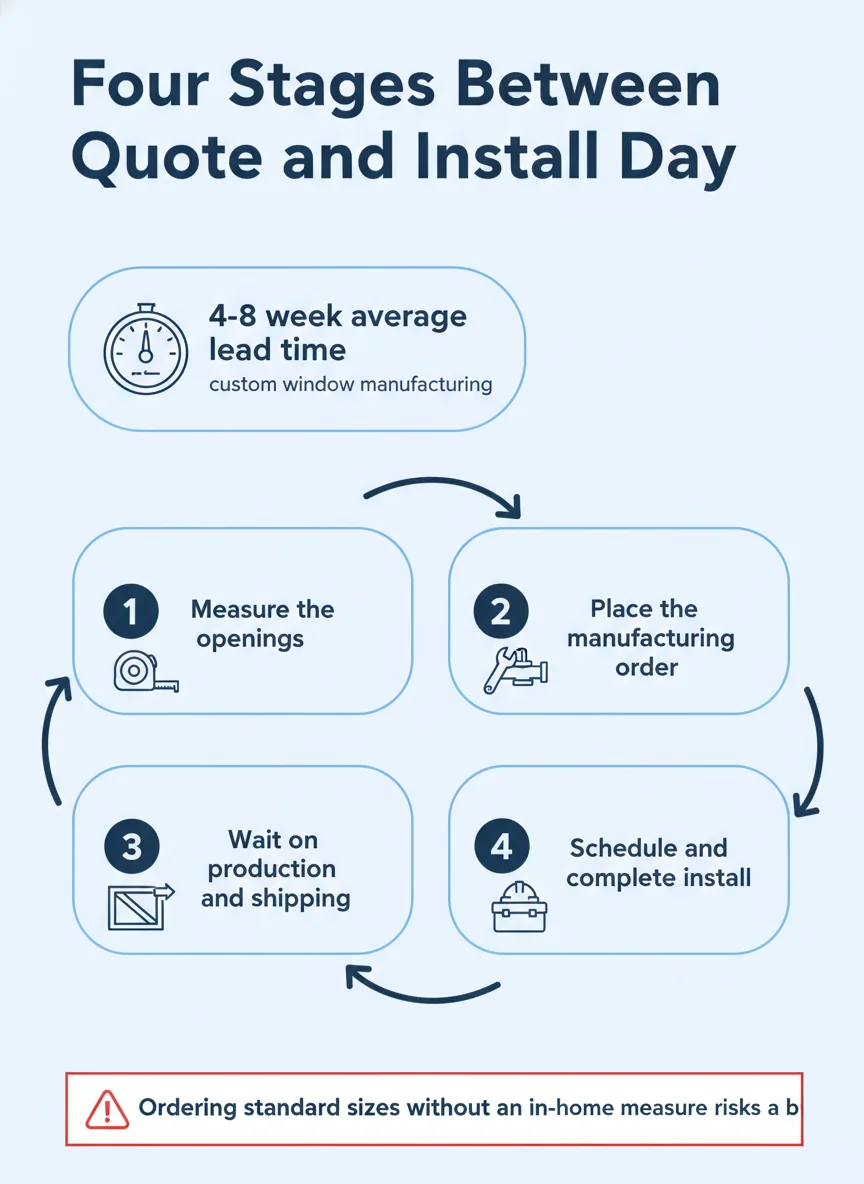
Here's the general sequence a window order follows once a homeowner decides to move forward, whether it's one window or window replacement across the whole house.
- Quote and style selection: The homeowner picks frame material, style, and glass package, and the project gets priced based on the number and type of openings.
- In-home measure: A technician measures each opening precisely, since the manufacturer builds to those exact numbers rather than a guess.
- Order placed with manufacturer: The confirmed measurements and specs go into the production queue at the window manufacturer.
- Manufacturing and quality check: Each window is built, sealed, and inspected before it's approved to ship from the factory.
- Shipping to the installer: Completed windows ship to the installation company, who confirms everything arrived correct and undamaged.
- Install scheduled: The installer reaches out to set an install date once the full order is in hand and ready.
- Install day: Old windows come out, new ones go in, and openings are sealed tight to finish the job.
What a Delay Usually Means
When a window order runs longer than expected, it's rarely a mystery once you know where to look. The most common culprit is a custom element somewhere in the order, whether that's an odd-shaped opening, a specialty color, or a glass upgrade that isn't part of the manufacturer's standard run.
Manufacturing backlogs
Manufacturers across the industry see demand swing seasonally, and a backlog at the factory level shows up as a longer wait regardless of who's installing the windows. This isn't something a local installer controls directly, but a good one will give an honest estimate up front and keep the homeowner updated if the timeline shifts.
Shipping delays can stack on top of manufacturing time too, especially for larger whole-house orders where everything needs to arrive together before scheduling can happen.
Measurement or order errors
The other common source of delay is an error caught after the order is already placed, like a dimension that doesn't match the opening once the window arrives. This is exactly why the in-home measure matters so much, and why a rushed or remote measurement is a risk not worth taking on a custom-built product.
If something does come back wrong, it typically means a reorder and another trip through the production queue, which is the single longest kind of delay a window project can hit.
What Homeowners Can Handle vs. What Needs a Pro
There's very little in the ordering and manufacturing stage a homeowner can speed up on their own, and that's by design. The measuring, ordering, and production steps are technical enough that an experienced installer is going to get a more accurate result than a DIY measurement, especially on openings that have shifted over the years.
Where a homeowner has real control is in the decisions made at the quote stage. Choosing a standard size or common finish over a custom shape, picking a basic glass package instead of a heavily upgraded one, and avoiding peak season if the timeline is flexible are all ways to keep the wait on the shorter end without touching anything technical.
Everything after the order is placed, the measuring, the manufacturing, the install itself, belongs with a licensed installer. That's true whether the project is one cracked window or a full exterior overhaul that includes siding and exteriors work alongside the windows.
Planning Your Window Project Around the Real Timeline
The best way to avoid frustration on a window project is to build the real timeline into the plan from day one. If there's a deadline, whether it's a change of season or a move-in date, get the quote and measure scheduled early enough that manufacturing time doesn't become the bottleneck. For more on what happens once the windows actually arrive, see how long window installation takes on install day.
Homeowners in Denver, Littleton, and across the metro who ask about timeline up front tend to have the smoothest projects, because there are no surprises about what's happening between the quote and the finished install. Precise Windows LLC walks through that timeline at the quote stage so there's a clear picture of what to expect before any order gets placed.
Frequently asked questions
How long does it take to get replacement windows after ordering?
Most replacement windows take several weeks to manufacture once the order is placed, since each window is built to the exact opening measurements rather than pulled off a shelf. Add a little time on either end for scheduling the measure visit and the install date, and the whole process from quote to finished window usually runs over a month.
Can I speed up a window order?
Standard sizes and common styles typically move faster through a manufacturer's production line than custom shapes, specialty glass, or less common colors. Asking your installer about in-stock or quick-ship options at the quote stage is the best way to find out what's realistic for your project.
Why do windows take so long to arrive compared to other home products?
Replacement windows are built to order because almost no two openings in an older home are exactly the same size. That custom manufacturing step, plus quality control and shipping, is what separates window lead times from something you could grab same-day at a hardware store.
Does the time of year affect how long windows take to get here?
Yes, demand swings with the seasons and manufacturers tend to get backed up heading into spring and fall when home improvement projects pick up across the region. Ordering in a slower season can sometimes shave time off the wait, though it's not guaranteed.
What happens between the measure visit and the install?
After the in-home measure, the order goes to the manufacturer for production, then ships to the installer once it's complete and inspected. The installer then reaches out to schedule install day once the windows are in hand and ready to go.