
Basement Windows Take More Abuse Than Any Other Window in a Colorado House
Every window on a house eventually needs replacing, but basement windows usually go first. They sit below grade, which means they're surrounded by soil and moisture on three sides, and in the Denver Metro they go through a freeze-thaw cycle every winter that most upstairs windows never see. Add in a window well that doesn't drain well and you've got a window fighting water pressure from the outside every time it snows or rains hard.
If you're looking at a basement window that's fogged up, won't latch, or has a frame that's gone soft at the bottom corner, you're not alone, and it's rarely a sign something's wrong with the rest of the house. It's just what happens to the window closest to the ground over a couple decades. This guide walks through why basement windows fail differently, what the replacement actually involves, and where a homeowner can reasonably do the work versus where it's worth calling in a pro.
Why Basement Windows Fail Before Windows Upstairs Do
Two things wear out a basement window faster than one upstairs: standing water and a shorter, wider frame shape that puts more stress on the seal at the sill. Once either one starts, the clock speeds up fast.
Moisture and the Window Well
A window well that's clogged with leaves, dirt, or an old liner holds water right against the frame every time it rains or the snow melts. That water finds its way past even a healthy seal eventually, and once it's inside the wall cavity it rots the wood framing around the opening from the inside out, long before you ever see a stain on the drywall.
A well-drained window well with a clear gravel bed and a working drain is the single biggest thing that extends a basement window's life. If you're replacing a window and the well hasn't been checked in years, it's worth doing both at once rather than putting a new window into the same wet pocket.
Frame Material and Below-Grade Exposure
Wood-framed basement windows from decades past don't hold up well against constant ground moisture, which is why most replacements today go in with vinyl frames instead. Vinyl doesn't rot, doesn't need repainting, and handles the swing between a cold concrete wall and a humid basement far better over the long haul.
For more on how vinyl frames perform over time in this climate, see How Long Do Vinyl Replacement Windows Last in Colorado?. The short version is that a vinyl basement window installed correctly, with good drainage behind it, will usually outlast the wood window it replaced by a wide margin.
| Style | Best for | Opens wide enough for egress? |
|---|---|---|
| Hopper | Narrow, short openings, ventilation only | No |
| Slider | Wider openings, easy inside operation | Only in larger sizes |
| Casement | Bedrooms needing a code-sized exit | Yes, in most sizes |
| Fixed/picture | Light only, no ventilation needed | No |
What's Inside a Basement Window Replacement
A basement window replacement has the same core parts as any window job: a frame, a sash, insulated glass, and a seal between the frame and the rough opening. The difference is what sits around it. Below grade, that opening is poured concrete or a concrete block wall rather than wood framing, so the window often sits in a metal or vinyl buck that's anchored directly into the foundation.
Outside, the window well itself, whether it's corrugated metal, poured concrete, or a modern composite well, is part of the system even though it's not technically part of the window. A new window installed into a failing well is still going to take on water eventually, which is why a good Window Replacement estimate on a basement window includes a look at the well, not just the glass.
Step-by-step: Replacing a Basement Window
The sequence below covers a standard swap into an existing opening. A job that involves resizing the opening for egress adds steps around cutting the foundation and isn't something to tackle without a contractor.
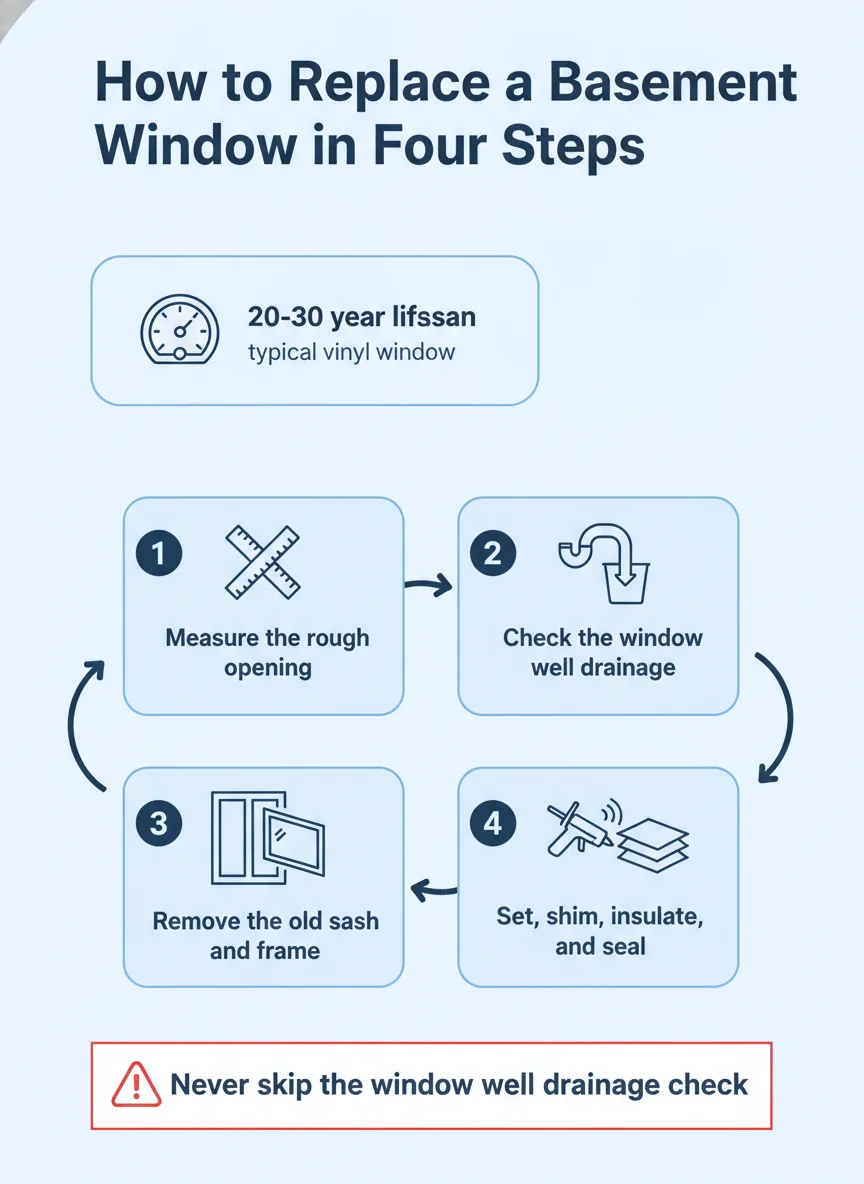
- Measure the rough opening: Measure width and height at three points each, inside the frame, and order the new window to the smallest of those measurements so it fits without forcing.
- Clear and inspect the window well: Pull out debris and old liner material and check that the drain at the bottom, if there is one, isn't clogged or silted over.
- Remove the old sash and frame: Cut or pry out the interior trim, then carefully remove the old frame without damaging the rough opening behind it.
- Check the opening for rot or gaps: Look at the framing or concrete buck around the opening for soft spots, cracks, or signs of past water intrusion before setting the new window.
- Set and shim the new window: Place the new frame into the opening, shim it level and square, then fasten it according to the manufacturer's instructions.
- Insulate and seal: Fill the gap between the frame and the rough opening with low-expansion foam or insulation, then seal the exterior joint with exterior-grade caulk.
- Test and finish trim: Open and close the window to confirm smooth operation, then reinstall or replace the interior trim and exterior well cover if there is one.
What You'll Find Once the Old Window Comes Out
Pulling the old frame tells you a lot about what's really going on at that opening, and it's often different from what the symptoms suggested from inside.
Signs the Frame Took on Water
Soft, dark, or crumbly wood around the opening means water has been getting in for a while, even if the drywall inside never showed a stain. This is common on older wood-framed basement windows and is one more reason vinyl has become the standard replacement material below grade.
If the framing around the opening is compromised, it needs to be repaired or rebuilt before the new window goes in. Setting a new frame into rotted wood just buys a few more years before the same problem shows up again.
Signs the Well Is the Real Problem
If the frame itself looks fine but there's dirt, standing water, or a crushed liner in the window well, the well is the thing that needs attention, not just the window. A new window set into an undrained well is working against the same water pressure the old one was.
This is also a good time to check nearby siding and trim, since a leaking window well can wick moisture up into the Siding & Exteriors at the foundation line over time.
DIY vs Calling a Pro for Basement Window Replacement
A basement window that's a straight swap into a sound, properly sized opening is a reasonable weekend project for a homeowner who's comfortable with a caulk gun and a level. Measuring correctly and getting the insulation and seal right around the frame are the two steps where most DIY basement window jobs go wrong.
Anything that touches the egress requirement for a bedroom, or that requires cutting or enlarging the opening in a poured concrete foundation, moves well past a DIY job. Resizing a below-grade opening involves structural considerations and is typically done with a permit and a contractor who does that kind of foundation work regularly.
A failing window well, visible rot in the framing, or water showing up inside the basement near the window are also good reasons to get a professional opinion before buying a window. It's cheaper to fix the real problem once than to replace the same window twice.
Getting a Basement Window Replaced in the Denver Metro
Basement windows aren't glamorous, but they're one of the most failure-prone spots in a Colorado house once moisture and freeze-thaw cycles get involved year after year. Getting the frame material, the seal, and the window well all working together is what makes a replacement actually last instead of becoming a repeat job in five years.
If a basement window in your home is fogged, stuck, or sitting in a well that never seems to drain right, it's worth having it looked at before another winter. Precise Windows LLC measures the opening, checks the well, and replaces basement windows across the Denver Metro.
Frequently asked questions
Do basement windows have to be a certain size?
If a basement room is used as a bedroom, local building code generally requires at least one window sized and placed to serve as an emergency exit, often called an egress window. Not every basement window needs to meet that standard, only the one serving a sleeping room, so check with your local building department before you order.
Can I replace a basement window myself?
You can replace a basement window yourself if it's a straightforward swap into an existing opening that's in good shape and doesn't need to meet egress sizing. Once you're cutting into the foundation, resizing the opening, or fixing a window well drainage problem, it moves into licensed contractor territory.
Why does my basement window keep fogging up or leaking?
Fogging between the panes means the seal on the insulated glass unit has failed and moist air has gotten in, which calls for glass or full window replacement rather than a repair. Water coming in around the frame usually points to a window well that's draining poorly or a seal that's worn out at the sill.
What type of window is best for a basement?
Hopper and slider styles are the most common choices for basements because they fit short, wide openings and are easy to operate from inside. For a bedroom that needs an egress-sized opening, a casement or larger slider is often used since it opens wide enough to meet exit requirements.
How long does it take to replace a basement window?
A single basement window replacement into an existing opening usually takes a matter of hours once the new window is on site. If the opening needs to be resized for egress or the window well needs rework, plan on it taking longer and likely more than one day.