
Why Do Window Screens Wear Out So Fast in Colorado?
Window screens in the Denver Metro take a harder beating than they do in most parts of the country because of the altitude and the swing between intense summer sun and dry winter cold. UV exposure at elevation breaks down the plastic coating on fiberglass mesh faster than it would at sea level, and the freeze-thaw cycle through fall and spring stresses the frame's corners and spline groove.
Add in pets pawing at the mesh, kids leaning on a screen door, and the occasional hailstorm, and it's common for a screen to need attention well before the window itself shows any wear. The good news is that screen mesh is one of the cheapest and most replaceable parts of a window, and fixing it yourself is a reasonable weekend project if you have the right materials and a little patience.
What Makes a Screen Fail Before the Glass Does?
A window screen is really two separate systems working together: the mesh that keeps bugs out and the frame and spline that hold that mesh under tension. Either one can fail on its own, which is why a torn screen doesn't always mean the whole frame needs to be replaced.
Sun and UV Exposure
Fiberglass and vinyl-coated mesh are both vulnerable to UV breakdown over time, which shows up as brittleness, fading, or small cracks that spread into tears. South and west-facing windows see the most direct sun through the afternoon, so screens on those windows typically need replacing more often than ones facing north or shaded by trees and overhangs.
Once mesh starts to go brittle, patching a small hole is only a short-term fix. The surrounding fibers are usually weakened too, and a patched screen tends to tear again nearby within a season. At that point it's more efficient to just re-screen the whole frame rather than keep patching the same corner.
Wind, Pets, and Everyday Wear
Mesh also fails from simple physical stress: a dog pushing against a screen door, a window opened and closed hundreds of times a year, or wind-driven debris during a spring storm. This kind of damage tends to show up as a clean tear or a stretched-out section rather than the all-over brittleness of UV damage.
Frames take their own kind of abuse. Aluminum frame corners can loosen or separate after repeated temperature swings, and a loose corner lets the whole screen bow out of its track. If the frame itself is warped or the corners won't stay together, re-screening alone won't solve the problem, and the frame should be replaced.
| Mesh Type | Durability | Best For |
|---|---|---|
| Standard fiberglass | 5-8 years with regular sun exposure | Most residential windows |
| Aluminum mesh | Longer-lasting but can dent or crease | High-wear doors and ground-floor windows |
| Pet-resistant mesh | Reinforced to resist tears and punctures | Homes with dogs or cats that paw at screens |
| Solar/UV-blocking mesh | Cuts glare and heat but costs more upfront | South and west-facing windows |
What's Actually Inside a Window Screen?
A window screen is simpler than most people picture: an aluminum or vinyl frame with a groove running around the inside edge, a length of rubber spline cord that presses into that groove, and a sheet of mesh trapped between the spline and the groove wall. The spline is what actually holds the mesh in place under tension, not glue or staples.
Corners are usually either welded (on higher-end aluminum frames) or held together with plastic corner keys that snap or screw into each frame piece. Corner keys are the most common failure point on an older screen, since the plastic gets brittle with age and can crack if the frame flexes.
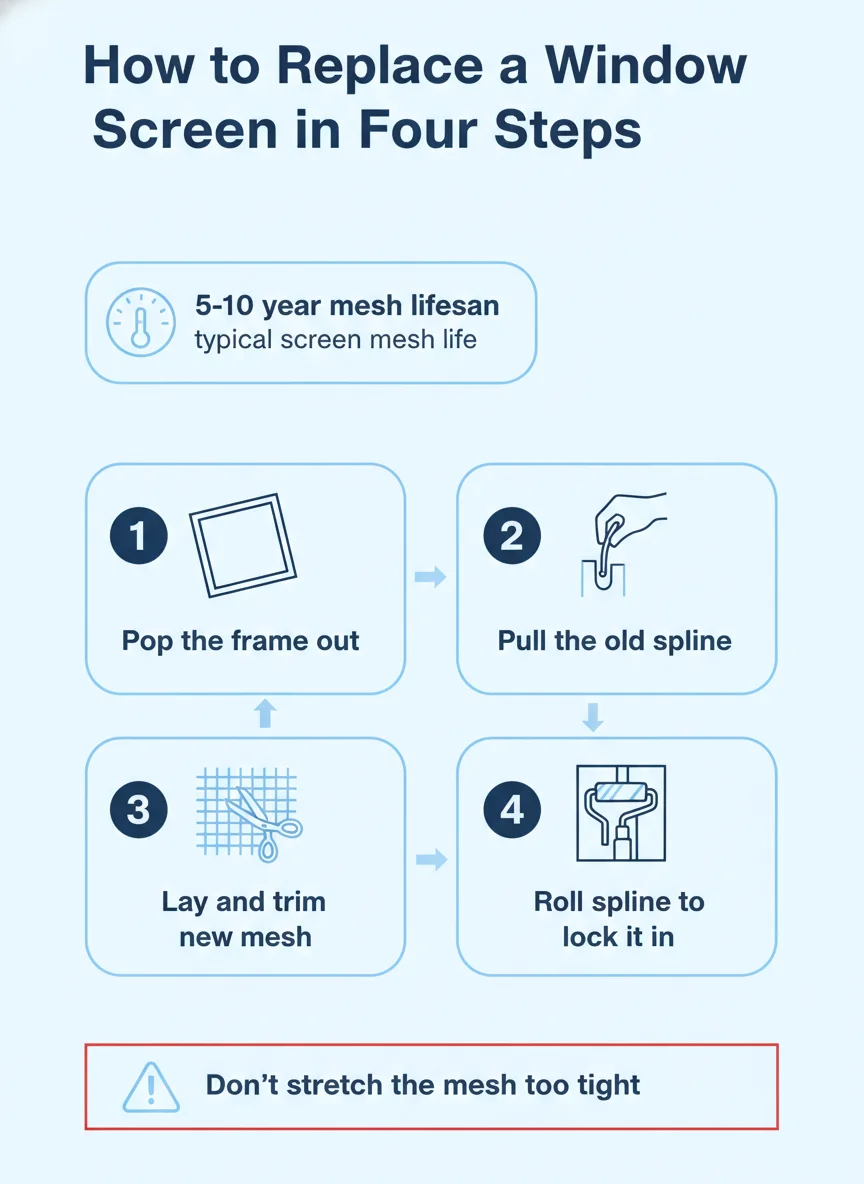
Step-by-Step: How to Replace a Window Screen
Replacing the mesh on a screen you already have is a straightforward job once the frame itself is in good shape. Lay the frame flat on a table or the floor before you start, since trying to re-screen it while it's hanging in the window track almost always leads to a crooked result.
- Remove the frame: Pop the screen frame out of the window track and set it on a flat, clean surface to work on.
- Pull the old spline: Use a flathead screwdriver or spline tool to pry the old spline cord out of the groove and discard the worn mesh.
- Lay the new mesh: Cut a piece of replacement mesh about two inches larger than the frame on all sides and lay it over the groove.
- Roll the spline in: Press new spline cord into the groove with a spline roller, working from one corner across to the opposite corner.
- Keep tension even: Apply gentle, consistent pressure on the mesh as you roll so it ends up snug but not stretched tight.
- Trim the excess: Cut away the extra mesh outside the spline line with a utility knife held at a slight angle.
- Reset the frame: Slide the finished screen back into the window track and check that it sits flush and moves freely.
How Do You Know If You Installed the Screen Correctly?
A correctly installed screen sits flat with no waves, the mesh has a slight drum-tight feel when you press on it, and the spline is fully seated below the surface of the frame groove with no gaps. If any of those aren't true, it's worth redoing before the screen goes back in the window.
Signs It's Installed Right
A good installation has mesh that's taut enough to spring back when you push on it but not so tight that it's distorting the frame. The spline should sit flush in the groove with no cord visible above the surface, and the corners should look square with no pulling or buckling along the edges.
When you slide the frame back into the window track, it should seat flush and slide or latch the way it always has. If it's binding or sitting crooked in the track, that's usually a sign the frame picked up a slight twist during the re-screening process rather than a problem with the mesh itself.
Signs You Need to Start Over
Loose, wavy mesh usually means the spline wasn't pressed in with even pressure, and it's worth pulling it back out and redoing that section rather than leaving it. Mesh that's stretched so tight it's pulling the frame corners inward is just as much of a problem, since it puts ongoing stress on the corner joints.
If the frame itself won't sit flat on a table, or a corner key has cracked and won't hold the pieces together, re-screening won't fix the underlying issue. At that point the frame needs to be replaced rather than just the mesh inside it.
Should You Replace a Screen Yourself or Call a Pro?
Re-screening a frame you already own is one of the most homeowner-friendly repairs in the whole window category. It requires no special tools beyond a spline roller, the materials are inexpensive, and a mistake just means pulling the spline back out and trying again.
Where it makes sense to call a pro is when the frame itself is bent, the corners have separated, or the screen is a custom size or specialty shape that isn't a standard off-the-shelf fit. Measuring a replacement frame incorrectly means ordering twice, and a bent frame that's forced back into a track can scratch or stress the window itself.
It's also worth having a professional take a look if torn or sagging screens are showing up on several windows at once, since that can point to a broader issue with the window openings or tracks rather than just worn-out mesh. A quick window and glass repair visit can sort out whether it's a screen problem or something with the window itself.
Keeping Screens and Windows Working Year-Round
A torn or sagging screen is easy to put off, but a frame that sits crooked in its track for too long can start rubbing on the window sash and wearing down the seal around it. Catching screen damage early and fixing it the same season keeps the rest of the window working the way it should.
If you're already dealing with screen issues on a window that's foggy, hard to lock, or original to a home it's outlived, it may be worth a broader look rather than a one-off fix. For more on how long windows in this climate are expected to hold up, see how long vinyl replacement windows last in Colorado, and for homes in Littleton and nearby towns dealing with a mix of screen and window wear at once, Precise Windows LLC can take a look at both in the same visit.
Frequently asked questions
Can I replace a window screen myself?
Yes, most homeowners can replace a torn or sagging screen in under an hour with a spline roller, replacement mesh, and new spline cord. The job only gets harder if the frame itself is bent or the corners have pulled apart, which calls for a frame repair instead of a mesh swap.
How often do window screens need to be replaced?
Screen mesh typically lasts five to ten years depending on sun exposure, pets, and how often the window gets opened and closed. Screens on south and west-facing windows in Colorado tend to wear out faster because of the stronger UV exposure at altitude.
What tools do I need to replace a window screen?
You'll need a spline roller, replacement screen mesh, new spline cord sized to your frame's groove, scissors or a utility knife, and a flat surface to work on. All of these are sold together as a basic screen repair kit at most hardware stores.
Why does my new screen look wavy or baggy after I install it?
A wavy or baggy screen almost always means the mesh was stretched unevenly or the spline wasn't rolled in with consistent pressure. Pull the spline back out, re-lay the mesh with gentle, even tension, and roll it in again working from one corner to the opposite corner.
Can a bent or broken screen frame be fixed, or does it need to be replaced?
A slightly bent aluminum frame can sometimes be straightened by hand or with a rubber mallet, but a frame with separated corners or deep creases usually needs a new frame rather than a repair. If the screen frame is custom-sized or part of a specialty window, it's worth having it measured by a professional before ordering a replacement.