
Why Accurate Measurements Matter Before You Order Windows
In the Denver metro, homes range from century-old brick two-stories in older neighborhoods to newer builds in Highlands Ranch and Aurora, and every one of them has window openings that have shifted a little over time. Wood framing dries out, foundations settle, and seasonal freeze-thaw cycles put small amounts of movement into a house year after year. None of that is usually a problem you can see from across the room, but it matters the moment you're ordering a window built to exact dimensions.
A window ordered from a quick, single measurement can come back too wide to set into the opening, or narrow enough to leave a gap that's hard to seal and insulate properly. Either mistake means a delay while a new unit gets built and shipped, which can stretch a straightforward window replacement project out by weeks. Taking the time to measure correctly up front, or having it done by someone experienced, is what keeps a project on schedule.
Why Window Openings Are Rarely Perfectly Square
No window opening is actually a perfect rectangle, even in a newer home. Lumber shrinks slightly as it cures, houses settle unevenly depending on soil and foundation type, and small amounts of twist get built into framing during original construction. That's why professional measuring always takes multiple readings across the opening rather than trusting one number for width and one for height.
Width: Where to Take the Three Measurements
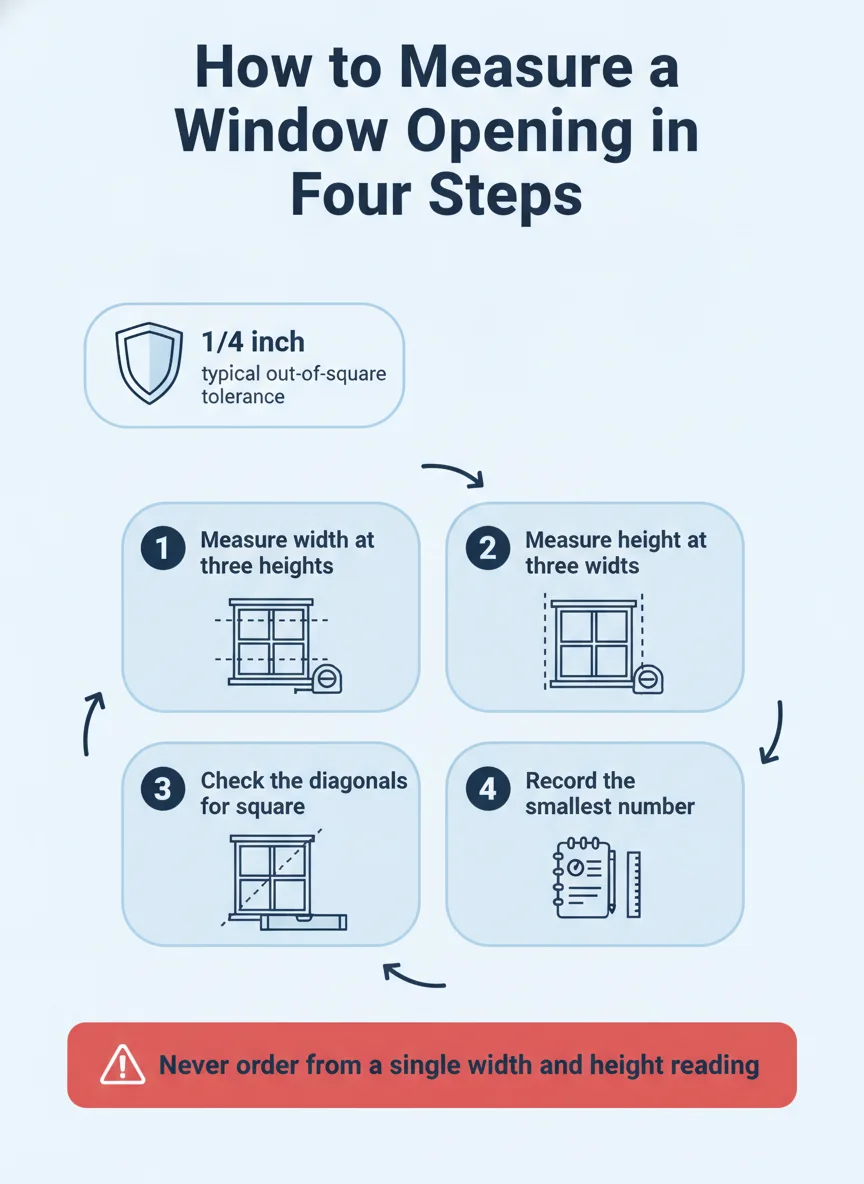
Width gets measured at the top of the opening, the middle, and the bottom, each one run from jamb to jamb (or from the inside face of the existing frame, for an insert replacement) at a right angle to the sides. These three numbers are often close but rarely identical, sometimes varying by a quarter inch or more in an older home.
The smallest of the three width measurements is the one that matters for ordering, since a window sized to the widest reading risks binding at the narrower point. This is one of the most common mistakes in a DIY measurement: using an average instead of the tightest dimension.
Height: Where to Take the Three Measurements
Height follows the same logic, measured at the left side, the center, and the right side of the opening, running from the sill up to the head jamb. Settling tends to show up more in height than width, especially in homes where the foundation has shifted slightly on one side over the years.
Again, the shortest of the three height measurements is the number to use. Ordering to the tallest reading can leave a window that won't seat properly against the sill, which creates the kind of gap that lets cold air and moisture into the wall cavity.
| Measurement Type | What You're Checking | Number to Use |
|---|---|---|
| Width (top, middle, bottom) | Jamb-to-jamb distance at three heights | The smallest of the three |
| Height (left, center, right) | Sill-to-head distance at three points | The smallest of the three |
| Diagonal corners | Difference between the two corner-to-corner measurements | Under 1/4 inch is typical, more means the opening is out of square |
| Depth | Distance from interior trim to exterior face of the frame | Determines whether an insert or full-frame unit fits |
The Parts of the Opening You're Actually Measuring
A window opening has a few distinct parts worth knowing before you pick up a tape measure. The head jamb is the horizontal piece at the top, the sill is the horizontal piece at the bottom (often sloped slightly to shed water), and the two side jambs connect them. Depth refers to how far back the frame sits, from the interior trim to the exterior sheathing or cladding.
That depth measurement decides whether a straightforward insert replacement will work, where the new window fits inside the existing frame, or whether the project needs a full-frame replacement that goes down to the rough opening in the wall. Siding type and trim details, covered in more depth in Siding & Exteriors work, can also affect how much depth is available at the exterior side of the opening.
Step-by-step: How to Measure a Window Opening for Replacement
The process is straightforward with a steel tape measure, a notepad, and a little patience. Working through it in order keeps you from missing one of the readings that actually matters for an accurate order.
- Measure width top: Run the tape jamb to jamb along the top of the opening, holding it level and square to the sides.
- Measure width middle and bottom: Repeat the same jamb-to-jamb measurement at the center and bottom of the opening, recording each number separately.
- Measure height left side: Measure from the sill to the head jamb along the left side of the opening, keeping the tape plumb.
- Measure height center and right: Repeat the sill-to-head measurement at the center and right side, again recording each one on its own.
- Check the diagonals: Measure corner to corner in both directions; a difference of more than about a quarter inch between the two means the opening is out of square.
- Measure the depth: Measure from the interior trim back to the exterior face of the frame to confirm how much room exists for an insert versus a full-frame unit.
- Record the smallest numbers: Use the smallest width and smallest height from your three readings each when the window gets ordered.
What Do Your Measurements Tell You About the Opening?
Once the numbers are on paper, they tell a story about the condition of the opening itself, not just its size. A tight, consistent set of measurements usually means a straightforward install. Wider variation points to settling or movement that needs to be planned around before the window arrives.
If the Opening Is Out of Square
A diagonal difference beyond roughly a quarter inch means the opening has racked slightly out of square, which is common in homes that have settled over the years. This doesn't rule out installing a new window, but it does mean the installer needs to plan for shimming and sealing unevenly to get a weathertight fit.
Ignoring an out-of-square reading and ordering a perfectly rectangular window anyway is one of the more common causes of a difficult install day, with gaps that are hard to seal evenly and a sash that may not operate smoothly once it's set.
If the Width or Height Varies by More Than a Quarter Inch
A variance that large across the three readings usually means there's enough settling or framing irregularity that the smallest measurement should be treated as the hard limit, not a rounded average. Ordering to a larger number in hopes of a tighter fit almost always backfires.
In older homes especially, it's worth double-checking these readings a second time before finalizing an order, since a transposed number or a tape measure held slightly off-square can throw off the final fit.
Measuring Yourself vs. Having a Pro Measure
A homeowner with a steady tape measure and some patience can absolutely take rough measurements to get a sense of scope and budget before reaching out for quotes. This works well for planning purposes, figuring out roughly how many openings need attention and what sizes are involved across the house.
Where it gets trickier is the final order. A window manufactured to the wrong dimension by even a half inch either way can mean a unit that won't set properly or won't seal against weather once it's in. That's why most installers, including our team, take their own measurements at the home before anything is ordered, regardless of what a homeowner measured beforehand.
There's no shame in doing your own rough numbers first. It's genuinely useful for narrowing down options and understanding the project before anyone sets foot on a ladder. Just treat those numbers as a starting point for the conversation, not the final word that goes on the order form.
Getting the Numbers Right Before You Order
Measuring correctly the first time is one of the simplest ways to avoid delays on a window project, and it's worth doing carefully whether you're planning one window or replacing every opening in the house. For more on what the whole project looks like from first measurement to final install, see What to Know Before Installing Replacement Windows in Colorado.
If the numbers feel uncertain, or the opening looks out of square, or you're just not sure which measurement to trust, it's worth having it checked before an order gets placed. Precise Windows LLC takes its own measurements at every home before any window gets ordered, so the fit is right the first time.
Frequently asked questions
Do I need to remove the old window before measuring?
No, you measure the opening with the existing window still in place for an insert replacement, working from the inside against the existing frame. A full-frame replacement requires different measurements taken down to the rough opening, which is usually a job for whoever is doing the install.
Why do I need three measurements for width and height instead of one?
Older homes settle and framing shifts over the years, so the top, middle, and bottom of an opening are rarely identical. Taking three readings and using the smallest number keeps the new window from binding against the narrowest point of the frame.
What does it mean if my window opening isn't square?
It means the frame has shifted slightly from the home settling, which is common in houses more than a decade or two old. A window can still be ordered and installed in a slightly out-of-square opening as long as the installer accounts for it with shimming and sealant.
Should I measure to the nearest inch or something more precise?
Precise measurements matter here, down to the eighth of an inch where possible, because window manufacturers build to tight tolerances. A rounded number can mean a window that's too tight to set or leaves a gap too wide to seal properly.
Can I use my old window's listed size to order a new one?
Not reliably, because the labeled size on an old window often reflects the manufacturer's original rough opening spec rather than the actual current opening after years of settling. Measuring the existing opening directly is the only way to know the real dimensions today.