
Windows don't quit overnight, they wear down for years first
Across the Denver Metro, homes see hot dry summers, cold winters, and wide swings in between, sometimes in the same week. That kind of temperature cycling is hard on a window frame and the seal around the glass, and it adds up faster than most homeowners expect. A window installed twenty years ago was built for a different era of glass and weatherstripping, and it's been expanding and contracting through every freeze-thaw cycle since.
The result isn't usually a dramatic failure. It's a slow creep: a draft that gets a little stronger each winter, a lock that takes a little more force, a pane that fogs up on cold mornings. Homeowners often live with these small annoyances for years before connecting them to the window itself, chalking it up to an old house or a cold room. Once you know what to look for, the signs are easier to catch early.
Why do windows fail in the first place?
Windows fail because the materials that keep air and moisture out, the seals, the weatherstripping, and the frame itself, break down with age and exposure. Every window has a design life, and once it's past that point, the components that kept it tight simply can't do the job anymore.
Seal failure in double-pane glass
Double-pane and triple-pane windows rely on a sealed gap between panes filled with insulating gas or dried air. That seal is the single most important part of the window's performance, and it's also the part most likely to fail over time. Once moisture gets into that gap, you'll see fog, a gray film, or visible condensation between the panes that no amount of cleaning will remove.
A failed seal doesn't just look bad, it means the window has lost most of its insulating value, because the gas or dead air space that was doing the work is gone. At that point the glass itself needs to be replaced, not cleaned or recaulked. It's one of the clearest, least ambiguous signs that a window is done.
Frame and weatherstripping wear
Wood frames can soften, swell, or split after years of sun and moisture exposure, especially on south and west-facing walls that take the most direct sun in Colorado. Vinyl frames hold up differently, but the rubber or foam weatherstripping inside them still hardens and shrinks with age, which is what lets drafts in even when the frame itself looks fine.
You can often feel this kind of failure before you can see it. Run a hand along the inside edge of the frame on a windy day and a draft that wasn't there a few years ago is a strong sign the seal around the sash has given out. A window that used to swing open easily and now sticks or drags is telling the same story from a different angle.
| Sign | What it usually means | Repair or replace |
|---|---|---|
| Fog or film between panes | Seal has failed, insulating gas is gone | Replace the glass unit |
| Draft at the frame edge | Weatherstripping has hardened or shrunk | Repair if isolated, replace if widespread |
| Window won't stay open or lock | Hardware worn or frame out of square | Often repairable at the opening |
| Soft, splitting wood sill | Moisture damage to the frame | Replace the unit |
What's actually inside a window unit
A modern window is more than a pane of glass in a frame. It's a sealed glass unit set into a sash, the sash fitted with weatherstripping against the frame, and the frame anchored into the rough opening with insulation and sealant around the edges. Every one of those layers has to work together to keep air and water out.
That's also why a window that looks fine from across the room can still be failing. A homeowner usually notices the glass, since fog and cracks are visible, but the weatherstripping, the sash fit, and the seal around the opening itself are just as often the real source of a draft. A proper window replacement addresses all of it at once, resealing the whole opening rather than just swapping glass.
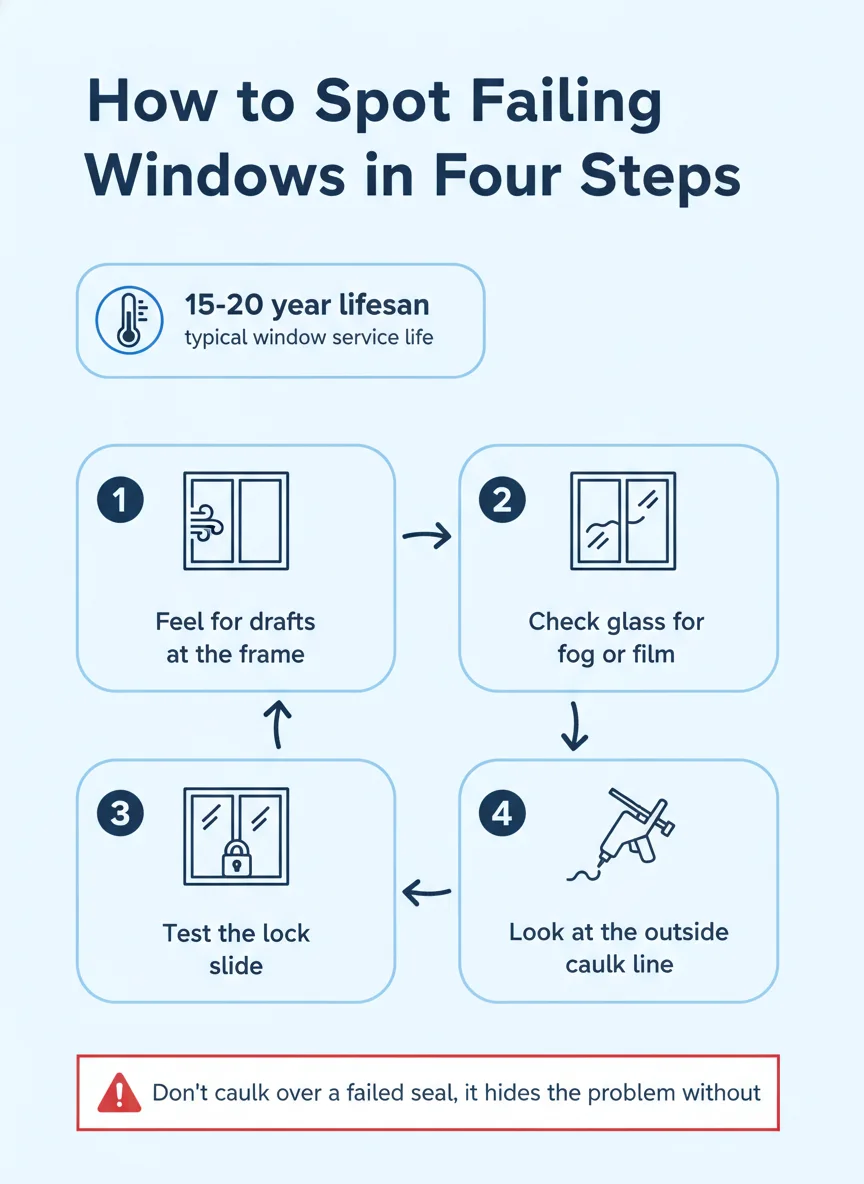
Step-by-step: how to check your own windows for failure
You don't need any tools to do a basic check on your windows, just a few minutes and a cold or windy day, when drafts and temperature differences are easiest to notice.
- Feel the frame edge: Run your hand slowly along the inside edge of the frame and sash on a cold or windy day. A cold draft here means the seal has failed.
- Check the glass for fog: Look at the glass in early morning light, when fog and gray film between the panes show up most clearly.
- Test the lock and slide: Open, close, and lock the window fully. Sticking, dragging, or a lock that won't catch means the frame or hardware has shifted.
- Look at the exterior caulk line: Cracked, missing, or chalky caulk around the outside frame lets water in behind the trim over time.
- Inspect the sill for softness: Press gently on the wood sill inside and out. Give or softness under light pressure usually means moisture damage.
- Listen for outside noise: A window that used to muffle traffic or street noise and no longer does has likely lost some of its seal integrity.
What you'll typically find once you start checking
Energy loss that shows up in the bill
The most common finding is energy loss, and it's usually the reason homeowners start looking into replacement in the first place. A room near a failing window runs colder in winter and hotter in summer than the rest of the house, and the furnace or air conditioner works harder to compensate, which shows up as a higher bill over time.
This kind of loss is gradual, so it's easy to miss until you compare bills year over year or notice one room is consistently uncomfortable no matter the thermostat setting. Once several windows in a home are affected, the cumulative effect is bigger than any single window would suggest.
Moisture and condensation issues
The second most common finding is moisture, either fogging inside a failed seal or condensation forming on the inside surface of the glass during cold weather. Interior condensation on single-pane glass is normal in cold climates, but condensation that's trapped between panes is a sign the seal is gone for good.
Left unaddressed, moisture at the frame can eventually reach the wall framing around the window, leading to rot or mold that's far more expensive to fix than the window itself. Catching it at the window stage, before it spreads to the wall, is the better outcome.
What you can check yourself and what needs a licensed pro
The draft check, the fog check, and the lock test are all things any homeowner can do without special tools, and they'll tell you a lot about whether a window needs attention. Cleaning tracks, replacing a torn screen, or tightening loose hardware are also reasonable DIY jobs for anyone comfortable with basic tools.
Replacing the glass unit itself, resealing the frame to the rough opening, or correcting a frame that's gone out of square is a different kind of job. It requires removing the old unit without damaging the surrounding wall, fitting the new unit precisely, and sealing it so water and air can't get behind the trim. Get that seal wrong and you've traded one source of drafts for another.
That's the line most homeowners draw: diagnose and do basic maintenance yourself, but bring in a licensed window company for the actual replacement. A free inspection before any work starts is the easiest way to find out which category a given window falls into, repair or full replacement, before you spend money guessing.
When it's time to stop patching and start replacing
A window that's drafty, fogged, hard to operate, and showing frame damage all at once has told you everything it's going to tell you. At that point, patching one symptom just means the next one shows up sooner, and the home keeps losing comfort and efficiency in the meantime. Homeowners in Englewood and across the metro tend to reach this point around the same time their heating bills start climbing for no obvious reason.
If you want a closer look at what the install itself involves once you've decided to move forward, how replacement windows are installed walks through the process step by step. Precise Windows LLC inspects the windows you're worried about and tells you straight whether it's a repair or a full replacement before any work gets scheduled.
Frequently asked questions
How do I know if my windows need to be replaced?
The clearest signs are a draft you can feel with your hand near the frame, fog or a gray film trapped between the panes, and a window that's hard to open, close, or lock. Wood that's soft or splitting at the sill and a frame that's visibly out of square are also strong signals. If two or more of these show up on the same window, repair usually isn't worth the labor anymore.
Does replacing windows actually lower heating and cooling bills?
Yes, in general, because a worn seal or single pane lets conditioned air leak out and outside air leak in all year. The size of the savings depends on how many windows you replace, your current frame condition, and your home's overall insulation, so results vary house to house. A home with several failed windows will usually see a bigger shift than a home replacing just one.
Is it better to replace one window at a time or do the whole house at once?
It depends on your budget and how uneven the problem is across the house. Doing the whole house at once means one install visit and consistent frames and hardware throughout, while replacing room by room lets you spread the cost out but can mean more than one visit over time. Either approach is workable; the main cost driver is total window count, not how you schedule the work.
Can old windows be repaired instead of replaced?
Sometimes, yes. A single cracked pane, a torn screen, or a sticky lock can often be repaired at the opening without replacing the whole unit. But fogged double-pane glass means the seal between the panes has failed, and that glass needs to be replaced because the seal can't be restored.
How long does it take to notice a difference after new windows go in?
Most homeowners notice the draft is gone and the room holds temperature better within the first few days, especially near the window itself. A quieter house is usually the next thing people mention, since new glass and a tight frame cut down outside noise too.