
Why Timing Matters for Colorado Homeowners
Denver metro homes see a wide swing between summer heat and winter cold, and windows sit at the front line of that swing every single day. A window that was fine five winters ago can quietly start losing its seal, its weatherstripping, or its ability to lock tight, and the homeowner often doesn't notice until a specific cold snap or windstorm makes the problem obvious. Knowing what to look for, and when in the window's life those signs typically show up, keeps you from either replacing too early or waiting until a small problem becomes an expensive one.
This matters across the whole region, not just older neighborhoods. Homes in Englewood, Lakewood, and Arvada built in different decades carry different original window styles, and each style ages differently depending on sun exposure, altitude, and how the frame material holds up over time. The goal of this guide is to help you separate a cosmetic issue from a real performance problem before you decide what to do next.
Why Windows Fail Over Time
Every window is a seal, a frame, and a piece of glass working together, and each of those three parts can fail on its own schedule. The seal between panes is usually the first to go, since it's a thin strip of material doing constant work against expansion and contraction from temperature swings. Once that seal breaks, moisture gets between the panes and you get the telltale fog that never fully clears, even on dry days.
Frame and Seal Breakdown
Wood frames can soften or rot where moisture collects, especially on north-facing walls that don't get much direct sun to dry them out. Vinyl and aluminum frames don't rot, but they can warp slightly over decades of heat cycling, which is often what causes a window to start sticking or no longer close flush against the frame.
The weatherstripping, the thin rubber or foam gasket around the sash, compresses and loses its spring over years of opening and closing. That's usually the source of a draft you can feel with your hand even when the window looks perfectly fine from across the room. It's a small part, but it does a lot of the actual work of keeping outside air outside.
Glass and Hardware Wear
Double and triple-pane glass relies on a sealed gas layer between panes to do its insulating work. Once that seal fails, you lose the insulating benefit even though the glass itself still looks intact, which is why fog between the panes is treated as a replace signal rather than a clean-it-and-move-on issue.
Hardware, the locks, cranks, and balances that let a window open and stay open, wears out through simple mechanical use. A window that won't stay up on its own, or a lock that no longer catches, is often a hardware problem rather than a sign the whole unit needs to go, which is why a proper inspection matters before assuming the worst.
| Sign | Usually Means | Typical Fix |
|---|---|---|
| Fog between panes | Seal failure | Replacement |
| Draft along frame | Worn weatherstripping or frame gap | Repair or replacement, depending on frame condition |
| Won't lock or stay open | Hardware wear | Repair |
| Soft or discolored wood frame | Moisture damage | Replacement |
What's Actually Inside a Window That Can Fail
A modern window is really three systems in one unit: the frame, which holds everything and anchors to the house; the sash, the moving part that holds the glass and opens; and the glazing, the glass itself along with its seal and any gas fill between panes. Each has its own wear pattern, and understanding which one is giving you trouble tells you whether you're looking at a repair or a full replacement.
The installation itself, how tightly the window is sealed into the rough opening in the wall, also plays a role separate from the window unit's own condition. A well-built window installed with a poor seal around the opening can draft just as badly as an older window, which is part of why window replacement work includes sealing the opening, not just swapping the unit.
Step-by-Step: How to Check Your Own Windows
You don't need special tools to get a good read on your windows' condition. A slow walk through the house on a cold or windy day, checking each window the same way, will tell you most of what you need to know before calling anyone.
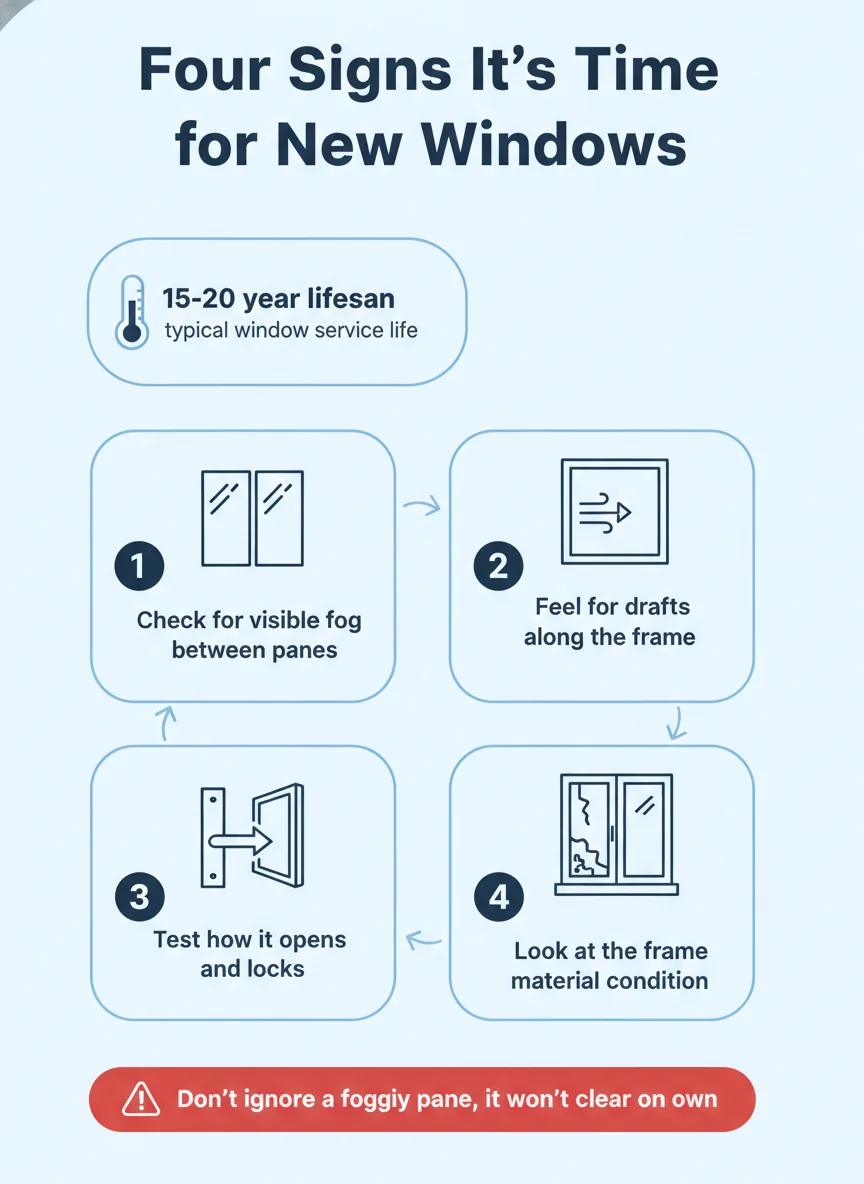
- Look at the glass: Check for cloudiness, fog, or a haze between the panes, especially in the corners where it often shows up first.
- Feel for drafts: Run your hand slowly around the frame and sash on a windy day to feel for air movement you can't see.
- Test the operation: Open, close, and lock each window to see if it moves smoothly and the lock catches fully.
- Check the frame material: Press gently on wood frames to feel for soft spots, and look for warping on vinyl or aluminum frames.
- Note the room feel: Pay attention to whether a room near certain windows always feels colder or has more condensation than the rest of the house.
- Count the affected windows: Tally how many windows show one or more signs so you know whether you're dealing with an isolated issue or a house-wide pattern.
- Get a professional opinion: A free inspection can confirm whether what you're seeing is a repair or a replacement situation before you commit to either.
What You'll Typically Find Once You Start Checking
Most homes don't need every window replaced at once. More often, a few windows, usually on the side of the house that takes the most weather, show problems well before the rest of the house does. South and west-facing windows tend to take the most sun exposure, while north-facing windows are more prone to moisture issues from less direct sunlight to dry them out.
Isolated Problems
If only one or two windows show signs of trouble, and the rest of the house feels fine, you're likely looking at a repair situation rather than a house-wide replacement. A cracked pane, a torn screen, or hardware that's failed on a single window is exactly the kind of thing window and glass repair is built to handle, often at the opening without touching the surrounding frame.
This is also the more budget-friendly path when it applies, since you're addressing a specific failure rather than replacing units that are still performing fine. A free inspection is the fastest way to confirm whether a problem is isolated before you decide.
House-Wide Patterns
If you're seeing fog, drafts, or sticking hardware across most of the windows in the house, and especially if they're all roughly the same age, you're likely dealing with windows that are simply reaching the end of their useful life together. That's a different conversation, one about window replacement on a broader scale rather than fixing each one as it fails.
Homes in Colorado that still have their original windows from construction often hit this point around the same time across the whole house, since the units all went in together and have weathered the same conditions since.
DIY vs. Calling a Pro
There's a real split between what a homeowner can reasonably check and fix themselves and what needs a licensed installer. Checking for drafts, fog, and sticking hardware, as covered above, is entirely something you can do on your own with no special tools, and it's worth doing before you call anyone so you can describe what you're seeing.
Weatherstripping replacement and minor hardware adjustments are also within reach for a handy homeowner, since the parts are generally available and the work doesn't touch the structural opening. Where it gets more involved is anything that requires removing the sash or frame, resealing the rough opening in the wall, or working with glass, since a poor seal at the opening can cause the exact drafts and moisture problems you're trying to fix in the first place.
A licensed installer also brings an eye for problems you might not catch on your own, like a frame that's slightly out of square or moisture damage inside the wall cavity that isn't visible until the old unit comes out. That's the value of a professional inspection even when you're fairly confident about what you're looking at.
Making the Call
The honest answer to when you should replace windows is: when the signs point to a failed seal, a damaged frame, or hardware and performance problems spread across most of the house, rather than on a fixed calendar schedule. Checking your own windows with the steps above gives you a clear starting point, whether that leads to a simple repair or a bigger conversation about replacement.
If you're weighing which path fits your situation, Is It Better to Repair or Replace Windows? goes deeper on that specific decision, and a free inspection from Precise Windows LLC can give you a straight answer on what your windows actually need.
Frequently asked questions
How do I know if my windows need to be replaced?
The clearest signs are fog or moisture trapped between the panes, drafts you can feel along the frame on a windy day, and windows that stick, won't lock, or won't stay open on their own. Wood frames that are soft or discolored and condensation that forms on the inside glass in winter are also strong indicators. If you're seeing two or more of these across several windows, it's worth getting an inspection rather than patching each one as it fails.
Is it better to replace all my windows at once or one at a time?
It depends on your budget and how uniform your current windows are. Replacing in phases, starting with the worst-performing rooms or the side of the house that takes the most sun and wind, spreads out the cost and still delivers noticeable comfort gains. Whole-house replacement is more efficient for the installer and often means a more consistent look and performance from room to room, so it comes down to what fits your timeline.
What time of year is best to replace windows in Colorado?
Most installers stay busy spring through fall, but windows can be replaced in any season since the work happens opening by opening, not with the whole house exposed at once. Scheduling before winter is popular because it locks in better comfort before the cold hits, while spring and summer bookings tend to have more flexible timing.
Can I just repair a window instead of replacing it?
Yes, if the problem is isolated, like a cracked pane, a torn screen, or hardware that's failed, a repair at the opening is usually the faster and more affordable fix. Replacement makes more sense when the frame itself is failing, the glass has lost its seal, or you're dealing with the same issues across most of the windows in the house.
Do older windows really cost more to keep than to replace?
Older single-pane or early double-pane windows generally lose more heat and let in more outside air than current construction, which shows up as rooms that are harder to keep comfortable near the glass. Whether replacing pencils out depends on how many windows are affected, their condition, and how long you plan to stay in the home, so it's a conversation worth having with an installer rather than a rule of thumb.