
When Window Glass Fails Before the Frame Does
It's a common surprise for homeowners across the Denver Metro, a window frame that still opens, closes, and locks fine, but the glass itself has gone foggy or cracked. That's a different repair than a full window replacement, and it's priced differently too, because you're only replacing the insulated glass unit inside a frame that's otherwise still doing its job.
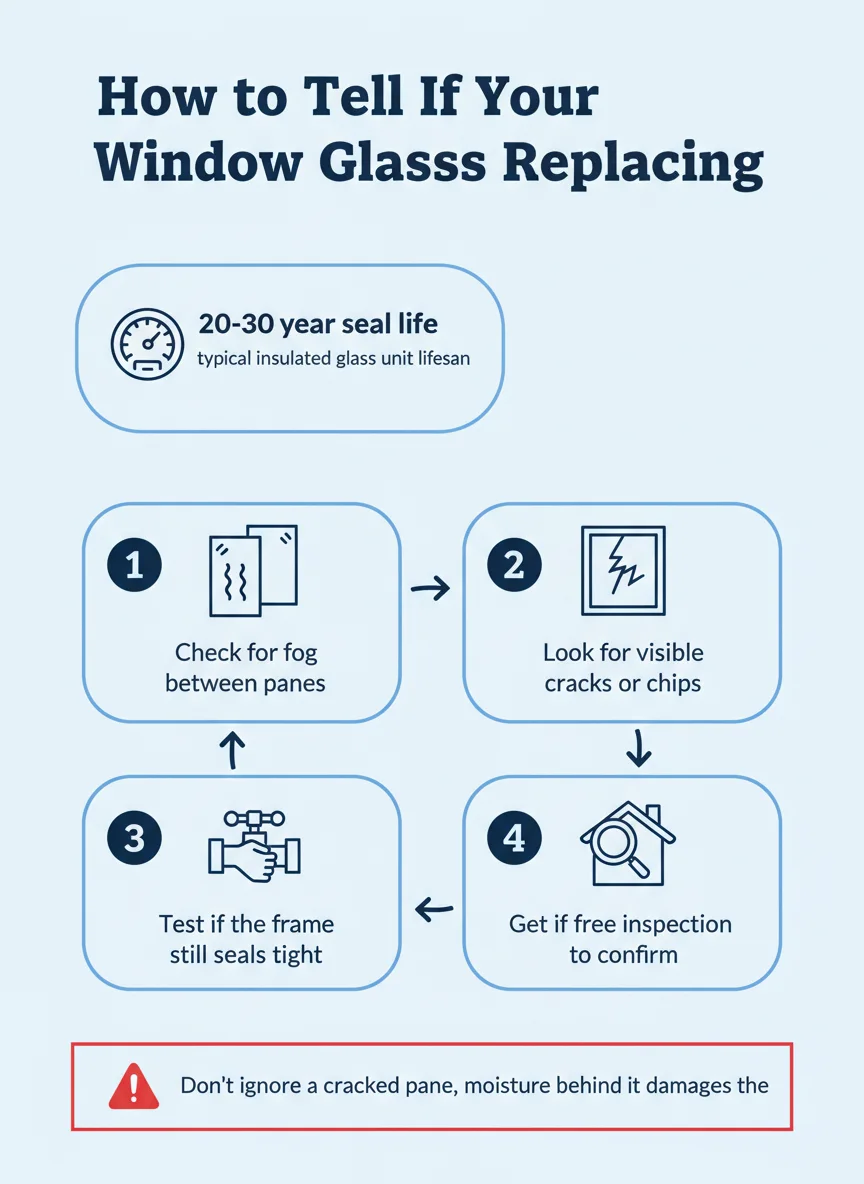
This kind of failure shows up more in this region than milder climates because of the temperature swings, big heat in summer, hard freezes in winter, that stress the seal on an insulated glass unit over time. Most units are built to hold their seal for 20 to 30 years, but UV exposure and repeated freeze-thaw cycles can shorten that window.
Why Glass Fails on Its Own Timeline
An insulated glass unit is really two or three panes of glass sealed together with a gas fill in between, and that seal is the part that eventually gives out, not the glass itself breaking down.
Seal Failure vs Impact Damage
Fogging between panes is a seal failure, moisture has worked its way into the gap between panes and it will not clear up on its own or with cleaning. Cracked or chipped glass is impact damage, from anything hitting the pane, and it's a separate problem from seal failure even though both end with the glass unit needing replacement.
Both situations point to the same fix, replacing the glass unit itself, but they show up differently. A homeowner might notice fogging gradually over months, while a crack from an impact is immediate and obvious the moment it happens.
Why the Frame Usually Survives Glass Failure
Frames are built to last much longer than the glass seal inside them, especially vinyl frames that resist warping through temperature swings. That's why glass-only replacement is possible so often, the frame, hardware, and weatherstripping are frequently still in good working order even when the glass unit inside has failed.
The exception is when water intrusion from a failed seal has gone unaddressed long enough to affect the frame or the surrounding wall. That's part of why an inspection matters before assuming it's a simple glass swap.
| Situation | Likely Fix | Why |
|---|---|---|
| Fogging between panes | Glass unit replacement | Seal has failed, frame usually still sound |
| Cracked or chipped pane | Glass unit replacement | Impact damage, frame typically unaffected |
| Frame warped or won't operate | Full window replacement | Frame failure needs more than a glass swap |
| Long-term water damage around frame | Full window replacement | Neglected seal failure can affect the wall behind it |
What's Inside a Replacement Glass Unit
A modern replacement glass unit is built from two or three panes sealed together with a spacer bar and a gas fill, often with a low-E coating on one surface to help manage heat transfer. That whole assembly gets manufactured to the exact size of your existing opening and then set back into the frame.
Getting that sizing right matters more than it sounds, an insulated glass unit has to fit precisely into the sash and frame to seal correctly, so accurate measurement before ordering is one of the more important steps in a glass replacement job.
Step-by-step: How Window Glass Gets Replaced
Glass-only replacement is a more contained job than a full window swap, but it still follows a clear sequence.
- Free inspection: A technician checks whether the frame is sound and confirms the issue is limited to the glass unit itself.
- Precise measurement: The exact opening size is measured so the replacement glass unit fits the sash without gaps.
- Glass unit ordered: The replacement unit is manufactured to match your chosen pane count and coating options.
- Old glass removed: The failed or damaged glass unit is carefully removed from the sash without disturbing the frame.
- New unit installed: The new glass unit is set and sealed into the existing sash and frame.
- Function check: The window is opened, closed, and locked to confirm it operates properly with the new glass in place.
What an Inspection Usually Finds
Glass-Only Cases
Most inspections for fogging or a single cracked pane confirm the frame is fine and the fix is a straightforward glass swap. These cases tend to move quickly since there's no framing work involved, just removing and replacing the glass unit itself.
Homeowners often assume the whole window needs replacing when they see fog, so it's a relief to learn the frame is salvageable and the fix is narrower and less disruptive than a full replacement.q
Cases That Turn Into a Full Replacement
Sometimes an inspection turns up more than glass failure, a frame that's warped, hardware that's worn out, or water damage that's spread beyond the glass unit. In those cases, glass-only replacement wouldn't solve the underlying problem, and a full window replacement is the more sensible recommendation.
This is exactly why a free inspection matters before assuming either direction, glass-only or full replacement. Guessing without a look at the frame risks paying for a glass swap that doesn't actually fix what's wrong.q
DIY vs Calling a Pro for Glass Replacement
Replacing an insulated glass unit is not a reasonable DIY project for most homeowners. The glass has to be measured precisely, ordered to the exact size, and set into the sash with the right seal, and mishandling a large glass unit is also a real safety risk.
What a homeowner can do is the early diagnosis, noticing fogging, checking for cracks, and testing whether the window still opens and locks properly before calling anyone. That observation helps a technician move faster during the inspection since you can point directly to the problem area.
Once it's confirmed the issue is in the glass, the removal, ordering, and reinstallation is best left to a window and glass repair team with experience handling insulated glass units and the equipment to move them safely.
Getting the Right Fix for Failed Glass
Fogging or cracked glass is frustrating to look at, but it's rarely a reason to replace an entire window if the frame is still sound. A free inspection tells you quickly whether you're looking at a glass-only swap or something bigger, and that answer should drive the decision, not a guess based on how the window looks from across the room.
If the issue turns out to be a torn screen instead of the glass itself, our window screen replacement guide covers that separately. Precise Windows LLC starts every glass repair call with a free inspection so you know exactly what you're dealing with before anything gets ordered.
Frequently asked questions
Why does window glass fog up between the panes?
Fogging between panes means the seal on the insulated glass unit has failed and let moisture in, which usually happens as glass ages past its typical 20 to 30 year seal life. Once that seal is broken it can't be resealed, the glass unit itself needs to be replaced.
Can you replace just the glass without replacing the whole window frame?
Yes, in most cases the glass unit can be replaced inside a frame that's still in good shape, which is usually less invasive and less costly than a full window replacement. This works well when the frame itself has no rot, warping, or operational problems.
How do I know if I need glass replacement or a full window replacement?
A free inspection is the most reliable way to tell, since a technician can check whether the frame is still sound and whether the fogging or cracking is limited to the glass unit. If the frame is warped, rotted, or won't operate properly, a full window replacement usually makes more sense than glass-only work.
Does cracked glass need to be fixed right away?
Yes, a cracked pane should get addressed promptly because moisture and air can get behind it and start affecting the frame and surrounding wall. Leaving it also increases the risk the crack spreads or the glass fails completely.
Is double-pane or triple-pane glass more expensive to replace?
Triple-pane glass units generally cost more to replace than double-pane because there's an extra pane and gas fill layer involved in manufacturing the unit. The trade-off is triple-pane typically offers better insulation performance once it's back in place.