
Why Denver Metro Homeowners Start Their Window Search at a Big-Box Store
When a window starts fogging up or a frame won't latch anymore, the first stop for a lot of homeowners in the Denver Metro area is a home improvement store, simply because it's familiar and the windows are sitting right there on display. It's a reasonable instinct. You can see a sample, touch the frame, and get a rough sense of cost before committing to anything.
The trouble is that a store aisle shows you a narrow slice of what's actually available, built around a handful of stock sizes and a couple of frame materials that move fast off the shelf. A house in Englewood or Arvada with original 1960s or 1970s window openings often doesn't match those stock dimensions cleanly, and that gap between what's in stock and what your house actually needs is where a lot of window shopping gets complicated.
What's Actually on the Shelf
Big-box retailers generally stock vinyl windows as their bread-and-butter option, since vinyl is affordable to manufacture at scale and performs reasonably well across a range of climates. You'll usually find double-hung and sliding styles as the volume sellers, with a smaller selection of casement, picture, and specialty shapes available by special order rather than sitting on the floor.
Frame Materials You'll Typically See
Vinyl dominates the in-stock selection because it's lightweight, doesn't need painting, and keeps manufacturing costs down. Some stores carry a composite or fiberglass option for shoppers wanting more rigidity or a different look, but those tend to be special-order rather than something you carry out the same day.
Wood and aluminum-clad wood windows show up far less often on a big-box shelf, since they're heavier, pricier, and typically ordered through a dealer rather than stocked. If you're after a specific wood interior look, you'll likely be routed to a catalog order either way, whether you're standing in a store aisle or talking to a window replacement company directly.
Glass Packages and Energy Options
Most stock windows at a home improvement store come with a basic double-pane, low-E glass package as the default, since that's the option that satisfies most energy codes without upcharging every customer. Upgraded glass, like triple-pane or specialty coatings for extra sun control, is usually an add-on you select when placing a custom order rather than something sitting pre-built on a shelf.
For a Colorado home dealing with intense summer sun at altitude and cold, dry winters, the glass package often matters more to comfort than the frame material does. It's worth asking specifically what glass is included in any quote, big-box or otherwise, rather than assuming it's the upgraded version.
| Factor | Big-Box Store Order | Local Window Company |
|---|---|---|
| Who measures your openings | In-store associate or a contracted measure tech | Our team measures at your home directly |
| Who installs the window | A contracted local install crew assigned by the retailer | Our own crew installs what we sold you |
| Style and brand selection | Limited to what's stocked or available by special order | Multiple brands and styles chosen for your specific opening |
| Who handles warranty questions | Routed through the retailer and manufacturer separately | One point of contact for the product and the install |
How the Buying Process Usually Works
A big-box window purchase typically follows a set pattern: you browse in-store or online, request a measurement visit, get a quote back, and then wait for the order to be manufactured before installation is scheduled. Because the retailer isn't the one measuring, ordering, and installing with its own crew, there are more handoffs between the moment you pay and the moment the window is actually in the wall.
That doesn't automatically make it a bad option, but it does mean more parties involved if something doesn't fit right or a seal fails down the line. Knowing who you'd actually call for a warranty issue, the store, the manufacturer, or the install subcontractor, is worth figuring out before you sign anything.
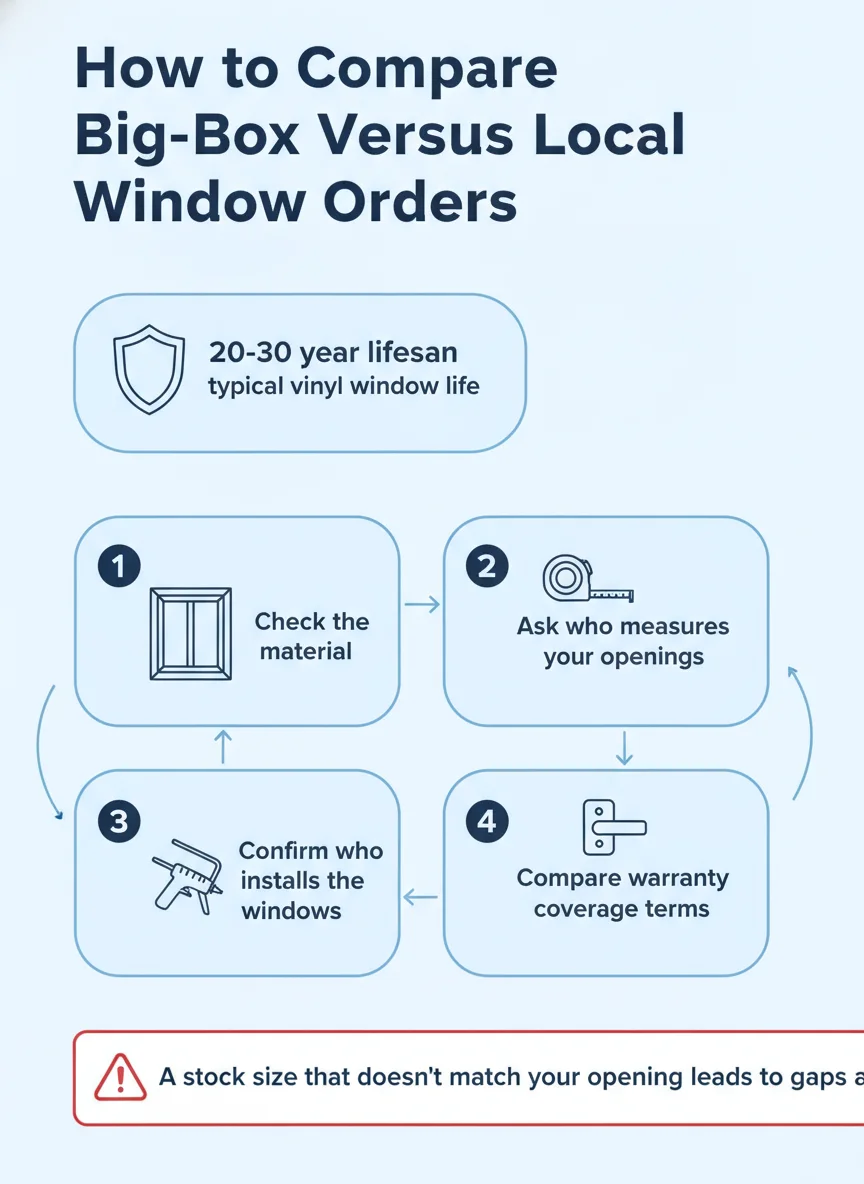
Step-by-Step: How to Evaluate Any Window Quote, Big-Box or Local
Whether you're standing in a store aisle or sitting across from a local estimator, the same checklist applies. Working through it keeps you from comparing apples to oranges when quotes come back different.
- Confirm the frame material: Ask specifically whether you're getting vinyl, composite, fiberglass, or wood, since that single detail changes cost, maintenance, and expected lifespan.
- Ask who measures: Find out if a professional measures your actual opening or if you're buying a stock size and hoping it fits close enough.
- Check the glass package: Confirm whether standard double-pane low-E glass is included or if any upgrade for sun control or extra insulation costs more.
- Identify the installer: Ask directly whether the company selling the window also installs it, or if installation is handled by a separate subcontracted crew.
- Read the warranty terms: Separate the manufacturer's product warranty from any labor or installation warranty, since they often come from two different sources.
- Compare lead times: Ask how long from order to install, since custom sizes and specialty finishes typically take longer than stock options.
- Get it in writing: Make sure the style, size, brand, glass package, and installer are all spelled out on paper before you commit to anything.
What You'll Find Once Installation Day Arrives
If the Fit Is Right
When the opening was measured accurately and the stock or custom size matches, installation is fairly straightforward. The old sash comes out, the new unit goes in, the gap around the frame gets sealed and insulated, and trim is reset. A clean fit shows up later as a window that opens and closes smoothly and doesn't let drafts through around the frame.
If the Fit Is Off
A stock-sized window forced into an opening that's slightly off creates gaps that get packed with extra shim and sealant rather than a true, snug fit. That often shows up months later as a draft you can feel with your hand near the frame, condensation between the sash and the trim, or a window that's harder to lock than it should be. It's one of the more common frustrations homeowners run into after a rushed, stock-size order.
What You Can Handle Yourself vs. What Needs a Pro
Picking a style, color, and rough budget range is something any homeowner can research on their own, whether that's browsing a store floor or looking through a local company's options online. Comparing frame materials and glass packages is also reasonable homework to do before anyone shows up with a tape measure.
Measuring the actual opening, ordering the correct size, and installing the unit so it's sealed, level, and weathertight is where a licensed, experienced installer earns their keep. An opening that's out of square by even a small amount, which is common in older Colorado framing, needs someone who's dealt with that specific problem before, not a best-guess fit from a stock catalog size.
If a quote or in-store associate can't clearly answer who's measuring your home and who's actually installing the window, that's worth pressing on before you commit. Those two answers tell you more about how the job will actually go than the brand name printed on the box.
Choosing Between a Store Shelf and a Local Installer
There's nothing wrong with browsing a big-box aisle to get a feel for styles and rough pricing before making a decision. It's a good first stop for research, and seeing frame samples in person helps a lot of people narrow down what they want.
When it's time to actually order and install, matching the window to your specific opening and having one company stand behind both the product and the labor tends to make the whole process smoother. Precise Windows LLC measures at your home, orders from several manufacturer options rather than a single stocked line, and installs what we sold you, so there's one number to call if anything needs a second look.
Frequently asked questions
Does Home Depot make its own windows or just sell other brands?
Home Depot sells windows made by outside manufacturers rather than producing its own line. The styles on display at a given store are usually a narrower selection chosen for broad appeal, not the full catalog a manufacturer offers.
Are big-box store windows custom-sized for my house?
Some big-box retailers offer measuring and ordering services that produce a custom-sized window, but the in-stock windows on the shelf are stock sizes meant for standard openings. An older Colorado home with settled or irregular framing often needs a true custom measurement rather than a stock fit.
Who installs the windows if I buy them from a home improvement store?
Big-box stores typically contract installation out to a network of local crews rather than employing installers directly. That means the company that sold you the window and the crew that installs it may be two different businesses with two different warranties.
Is it cheaper to buy windows from a home improvement store and have them installed?
It depends more on the window's size, frame material, and glass package than on where you bought it, since labor and site conditions drive a large share of the total. A custom opening, an odd shape, or a second-story install can erase any shelf-price advantage once installation is factored in.
What's the difference between a retail window and a window installed by a local company?
The window itself may be similar, but the measuring, the install crew, and who stands behind the finished job usually differ. A local installer measures your exact openings, installs the window personally, and handles warranty questions directly instead of routing you through a call center.