
A Cloudy Pane in a Denver Metro Home
Colorado's swing between hot, dry summers and hard winter freezes puts a lot of stress on the seals that hold a window's glass together. In the Denver metro, from Englewood out through Aurora and Lakewood, that stress shows up as foggy glass, condensation trapped between panes, or a crack that spreads a little more every cold snap. The instinct is to assume the whole window needs to go.
That instinct is often wrong. A window is really two separate systems: the frame and sash that hold everything in place, and the glass unit sitting inside it. When only the glass has failed, a full replacement can be more work and more money than the problem calls for. Knowing which system actually failed is the first step to deciding what this repair should look like.
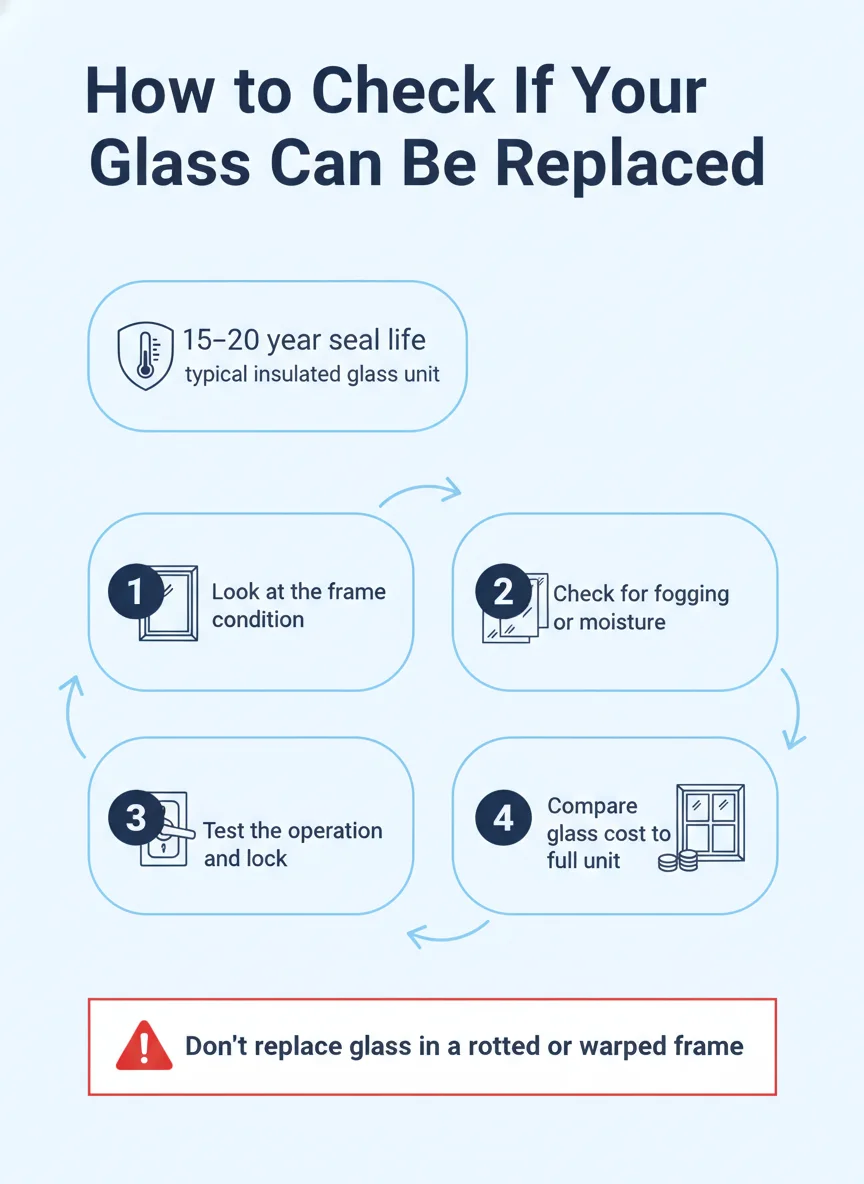
Why Window Glass Fails Before the Frame Does
Most modern windows use an insulated glass unit, two or three panes of glass sealed together with a spacer and a gas fill in between. That seal is a rubber and desiccant system, and like any seal, it has a working life. Once it breaks down, moisture gets in, the gas fill leaks out, and you start seeing fog, streaking, or a hazy ring around the edges.
Seal failure versus frame failure
Seal failure is a glass problem. The frame keeps doing its job, holding the unit square, locking tight, and sealing against the wall, while the glass itself loses clarity and insulating value. This is the scenario where glass-only replacement usually makes the most sense, because the part that's actually broken is isolated and replaceable without touching the rest of the window.
Frame failure looks different. Wood that's soft or swollen, vinyl that's warped from sun exposure, or a sash that won't stay up or lock properly all point to a structural issue that a new piece of glass won't fix. If the frame is compromised, putting fresh glass into it just delays a bigger repair.
Impact damage versus age-related fog
A cracked pane from an impact, a thrown rock, a branch, a stray baseball, is usually a clean glass-only fix if the frame wasn't damaged in the same event. The glass unit gets pulled and a new one measured to match goes back into the same opening.
Age-related fog is slower and tells its own story. If one or two windows in a 15 to 20 year old house start fogging while the rest are fine, that's normal seal wear working through the batch on its own schedule, not a sign the whole house needs new windows at once.
| Situation | Glass-only replacement | Full window replacement |
|---|---|---|
| Fogged double-pane, solid frame | Usually the right call | Not needed |
| Cracked pane, frame undamaged | Usually the right call | Not needed |
| Warped or soft frame | Won't solve it | Needed |
| Window won't lock or seal at the frame | Won't solve it | Needed |
What's Actually Inside the Glass Unit
An insulated glass unit is built from two panes of glass, a spacer bar that sets the gap between them, a sealant that bonds the whole assembly, and often an inert gas fill like argon that slows heat transfer through the gap. Some units add a low-emissivity coating, a thin, invisible layer that reflects heat while still letting light through.
When a replacement glass unit goes in, it's built to match the thickness and glass type of the original so it fits the existing sash without modification. Getting that measurement right, including the spacer width and any coating, is what makes a glass-only swap work cleanly instead of fighting the frame on install day.
Step-by-Step: How a Glass-Only Replacement Works
The process is more straightforward than people expect once the frame has been confirmed sound. Here's generally how it goes from first look to finished window.
- Inspect the frame: A tech checks that the frame, sash, and hardware are solid before recommending glass-only work. If the frame has issues, that gets flagged first.
- Measure the opening: Exact width, height, and glass thickness get recorded, along with spacer size and any coating or gas fill in the current unit.
- Order the matching unit: A new insulated glass unit is built or sourced to match those specs so it drops into the existing sash without reworking the frame.
- Remove the old glass: The failed unit is carefully pulled from the sash, and the channel is cleaned out so the new glass seats properly.
- Set the new unit: The replacement glass goes into the sash with fresh glazing or gasket material to seal it against air and moisture.
- Check operation and seal: The window is opened, closed, and locked to confirm it operates smoothly and seals tight around the new glass.
What You'll Find Once the Old Glass Comes Out
Good news scenarios
Most of the time, pulling the failed glass unit confirms what the inspection already suggested: the sash channel is clean, the frame is square, and the new glass seats right in without any extra work. This is the outcome that makes glass-only replacement worth doing, a targeted fix on a window that otherwise has plenty of life left.
In these cases, the rest of the window, the hardware, the weatherstripping, the frame finish, stays untouched. You get a clear, properly sealed pane back in a window that already fits the house and matches its neighbors.
When it turns into more
Sometimes removing the old glass reveals rot in the sash channel, a cracked frame corner, or hardware that's seized up from years of moisture getting past a failed seal. When that happens, glass-only replacement isn't enough on its own anymore.
That's the point where a window replacement conversation makes more sense than patching glass into a frame that won't hold up much longer. It's also why an honest inspection before any work starts matters more than guessing from the driveway.
DIY Versus Calling a Pro
A homeowner can reasonably handle small jobs around this repair: cleaning the sash channel, checking weatherstripping for wear, or doing a basic visual inspection to see if fog is isolated to one or two windows. These don't require special tools and give you useful information before you call anyone.
Actually removing and resetting a glass unit is a different matter. Insulated glass is heavy, sharp at the edges, and easy to crack further if it's handled wrong, and getting the glazing seal right takes practice most homeowners don't have reason to build. A mismeasured unit also won't seal properly, which puts you right back where you started.
A licensed pro brings the measuring tools, the supplier relationships to source a matching glass unit, and the experience to know in thirty seconds whether a frame is worth saving. That judgment call, more than the labor itself, is usually what you're paying for.
Getting an Honest Answer Before You Spend Anything
The short version: if the frame is solid and the glass is the only thing that's failed, replacing just the glass is almost always worth it over a full window swap. If the frame is compromised, no amount of new glass fixes that, and it's worth being told that plainly instead of sold a bigger job than the house needs, or a smaller one than it needs.
If you're weighing a full window swap against a glass-only fix elsewhere in the house, the considerations in is it worth replacing all the windows in a house at once cover that decision from the other direction. For a straight look at what's going on with your own windows, from Englewood out across the metro, Precise Windows LLC inspects the frame and the glass before recommending either one.
Frequently asked questions
Can you just replace the glass in a window instead of the whole window?
Yes, in many cases the glass unit (called an insulated glass unit, or IGU) can be swapped out on its own if the frame and sash are still in good shape. This works especially well on newer vinyl or fiberglass windows where the frame isn't the problem, just the sealed glass inside it.
Why does window glass fog up between the panes?
Fogging happens when the seal around the insulated glass unit fails and lets moisture into the gap between the panes. Once that seal breaks, the gas fill that helps with insulation also tends to leak out, so the window loses some of its energy performance along with the clear view.
Is replacing glass cheaper than replacing the whole window?
Glass-only replacement is usually less involved than a full window swap since it skips removing and resetting the frame and the surrounding trim. How much it actually saves depends on the window's age, brand availability, and whether the frame needs any repair at the same time.
How do you know if it's the glass or the whole window that needs to go?
Check the frame first. If the frame is solid, operates smoothly, and locks properly, and the only issue is fogged or cracked glass, a glass-only replacement is often enough. If the frame is warped, rotted, drafty, or hard to open, the glass is rarely the only thing wrong.
Can old single-pane glass be upgraded to double-pane in the same frame?
Sometimes, if the frame has enough depth and is structurally sound, but many older single-pane frames weren't built for a thicker insulated unit. A [window and glass repair](/services/window-glass-repair) visit can confirm whether your specific frame can accept an upgraded glass pack.