
Why Window Seals Fail in Denver Metro Homes
Front Range weather is hard on window seals in a way flatter, milder climates aren't. Summer afternoons can swing from sun-baked to a sudden hailstorm, and winter nights drop the glass temperature well below the heated air inside the house. Every one of those swings flexes the sealant that holds the insulated glass unit together, and over enough years that flex turns into a crack you can't see until moisture gets in.
If you've noticed a cloudy patch on a window that won't wipe clean, or felt a draft along a frame that used to seal tight, you're probably looking at a failed seal rather than a dirty pane. It's a common enough issue across Englewood, Denver, and the rest of the Denver Metro that most homeowners run into it on at least one window before the house hits the twenty-year mark.
What Causes a Window Seal to Fail?
A window seal is doing one job: keeping the gas or dehydrated air between the two panes locked in place while keeping outside moisture out. When that seal breaks down, the barrier stops working and the space between the panes starts behaving like the outside air, humidity and all.
Thermal Cycling and the Insulated Glass Unit
Every insulated glass unit is built around a spacer bar and a bead of sealant that holds the two panes apart at a fixed gap. As the glass heats and cools through the day, that gap expands and contracts slightly, and the sealant has to flex along with it thousands of times a year.
Colorado's wide daily temperature swings put more stress on that sealant than a milder climate would. Over years of expansion and contraction, the bond can crack at a corner or along an edge, and that's the point where outside air starts working its way in.
Age, Sun Exposure, and Seal Material Breakdown
South and west-facing windows take the brunt of direct sun for a Denver Metro home, and UV exposure breaks down sealant compounds faster than shaded windows ever see. It's common for the sunniest windows in a house to be the first ones to fog, even when every window was installed at the same time.
Age plays a role too. A seal that's held up fine for over a decade is simply closer to the end of its expected service life, and once the sealant starts to stiffen and crack, a bump, a slammed sash, or another hot summer can be enough to push it over the edge.
| Factor | Reseal or Glass-Unit Swap | Full Window Replacement |
|---|---|---|
| Frame condition | Works when the frame is sound and square | Needed when the frame is warped, rotted, or soft |
| Glass unit availability | Possible if a matching replacement unit exists | Not a factor, new unit comes with the window |
| Hardware and operation | Leaves existing locks and balances as-is | Replaces hardware along with the window |
| Other windows in the house | Fine for an isolated single-pane failure | Makes more sense when several windows are failing at once |
What's Inside a Window Seal System
An insulated glass unit is more than two sheets of glass stuck together. A metal or composite spacer bar runs around the perimeter, holding the panes at a fixed distance apart, and a bead of sealant runs along the outside edge of that spacer to lock out moisture and air.
Inside the spacer is a small amount of desiccant, a drying agent that soaks up any trace moisture left in the unit when it was manufactured. Once the outer seal cracks, that desiccant gets overwhelmed fast, and the fog you see between the panes is moisture the desiccant can no longer absorb.
Step-by-step: How We Check a Failing Seal
A proper seal diagnosis looks at the whole window, not just the foggy spot, since a failed seal is often a sign the surrounding frame and hardware are due for a look too.
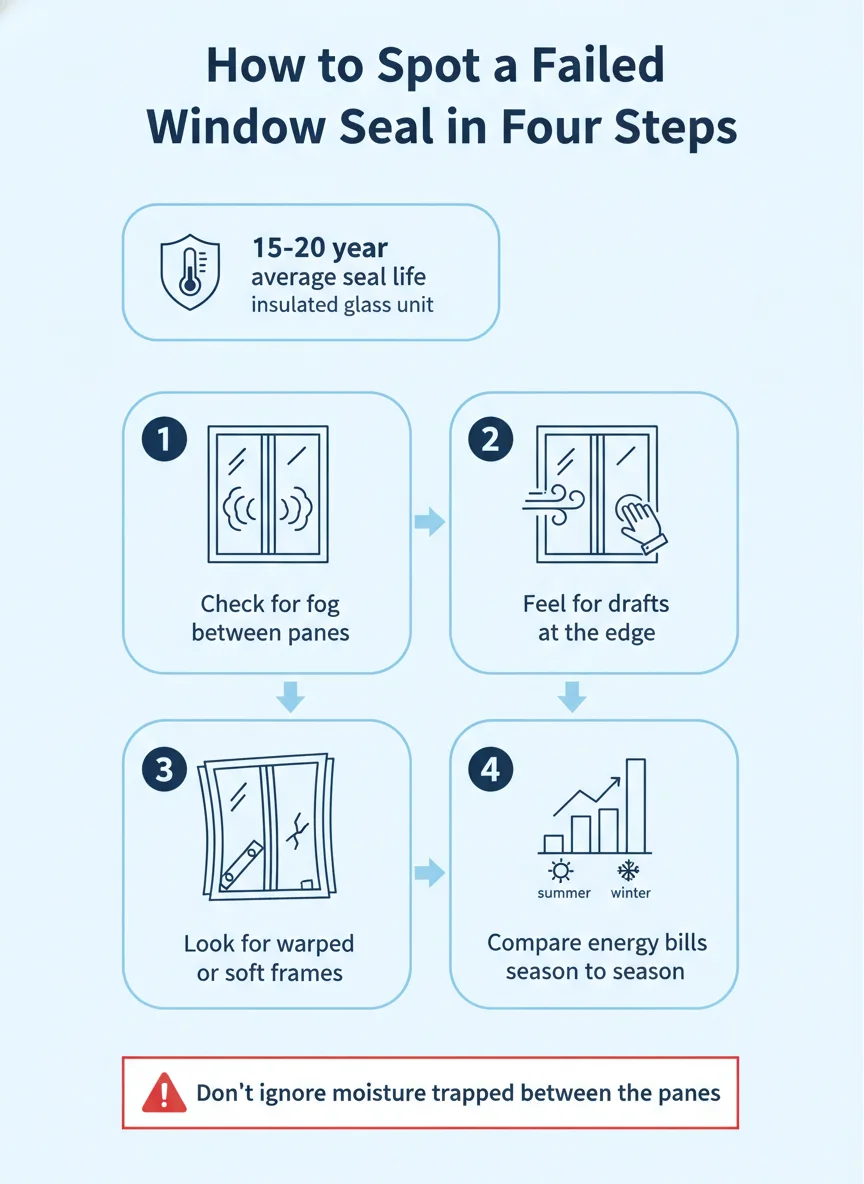
- Inspect the glass: We look for fog, haze, or mineral streaking between the panes, which confirms the seal has broken down rather than the glass being dirty.
- Check the frame: We check the surrounding frame and sash for warping, soft wood, or rot that would rule out a simple glass-unit swap.
- Test for drafts: We run a hand along the sash edges to feel for air movement, which often points to a failed seal even before fog shows up.
- Review the hardware: We check locks, balances, and the operation of the sash, since aging hardware often fails around the same time as the seal.
- Measure the opening: If a glass unit or full window is the fix, we measure the opening at the home so the replacement fits the existing rough opening correctly.
- Walk through options: We explain whether a glass-unit swap or a full window replacement fits the situation, and what that means for the rest of the windows in the house.
What a Failed Seal Looks Like
Fog and Condensation Between the Panes
The clearest sign is fog or condensation sitting between the two panes of glass, usually worse on cold mornings or after a hot afternoon. It won't wipe off from either side because it's trapped inside the sealed unit itself.
Over time that trapped moisture can leave behind a permanent haze or mineral streaking even after the air inside dries out, since minerals in the moisture settle on the glass surface and stay there.
Drafts, Moisture, and Higher Energy Bills
A failed seal doesn't always show up as visible fog first. Sometimes the first sign is a draft at the edge of the frame, a window that feels cold to the touch even when it's closed, or a noticeable jump in heating costs during a Colorado winter.
If you're seeing that kind of change on one or two windows while the rest of the house feels normal, it's worth having those specific windows checked rather than assuming the whole house needs new glass.
DIY vs Calling a Pro
There's not much a homeowner can safely do about a failed seal beyond diagnosing it. You can spot the fog, feel for the draft, and get a sense of whether it's one window or several, but opening up the sash or pulling the glass unit isn't a weekend project most people are set up for.
Swapping an insulated glass unit inside an existing frame takes the right measurements, a matching unit, and careful handling so the new unit seals correctly against the frame. Get that wrong and you're right back to a draft or fog within a year or two.
A full window replacement is even less of a DIY call, since it involves removing the old unit, checking the rough opening, and sealing the new window against the wall assembly so water can't get behind it. That's the kind of work worth having a window and glass repair visit from a licensed pro handle, especially if more than one window in the house is showing the same signs.
Deciding If It's Worth It
A single foggy window on an otherwise sound frame is often worth fixing with a glass-unit swap rather than a full replacement, especially if the rest of the window is in good shape. But if you're seeing the same fog or drafts on several windows, or the frames themselves are showing age, it usually makes more financial sense to replace the windows outright rather than patch one unit at a time. If you want help figuring out which situation you're in, How Long Do Replacement Windows Last? is a good next read.
Homeowners in Littleton and across the rest of the Denver Metro deal with this same decision every year as older windows hit the age where seals start to give out. Precise Windows LLC inspects failed seals, explains what's actually driving the fog or draft, and lays out whether a glass-unit swap or a full replacement is the right call for your windows.
Frequently asked questions
Can a window seal be repaired without replacing the whole window?
In some cases a failed seal can be addressed by swapping just the insulated glass unit inside the existing frame, which is cheaper than a full window replacement. Whether that's possible depends on the frame's age, condition, and whether a matching glass unit is still available for that window.
What does a foggy window between the panes mean?
Fog or condensation trapped between the panes means the seal around the insulated glass unit has failed and moist air has gotten inside. It's not a cleaning problem, it's a seal problem, and it won't clear up on its own.
How long do window seals usually last?
Insulated glass unit seals typically hold up for 15 to 20 years before the sealant and desiccant start to break down from sun, temperature swings, and age. Windows installed before that range are the ones most likely to show fog or drafts first.
Is it cheaper to reseal a window or replace it?
Cost depends on the window's age, the frame material, and whether the glass unit alone can be swapped without touching the frame. Older frames, warped sashes, or hardware that's already failing usually tip the math toward full replacement instead of a single-pane fix.
Does a failed window seal affect my energy bill?
Yes, a failed seal lets the insulating gas or air pocket between the panes escape, which weakens the window's ability to block heat and cold. Homeowners often notice higher heating and cooling costs around the same time they first spot the fog.