
A Term That Doesn't Translate to Colorado Projects
Search long enough about replacement windows and you'll eventually run into the acronym FENSA. It shows up on UK home-improvement forums, in listings for houses in England and Wales, and in articles written for a British audience. If you're planning a window project in Englewood or anywhere else in the Denver metro, it's a fair question whether that same paperwork applies to you.
The short answer is that it doesn't. FENSA is a British compliance scheme with no jurisdiction in the United States. That doesn't mean Colorado window projects are free of documentation entirely, it means the documentation that matters here looks different, and it's worth knowing what to ask for in its place before you sign a contract for window replacement.
Why US Window Projects Use a Different Compliance Path
Every country sets its own rules for who signs off on exterior building work, and the mechanism behind FENSA explains why it never crossed the Atlantic. It was built around a specific UK regulatory structure, and the United States runs its own separate system through state and local building codes.
How the UK System Works
In England and Wales, window and door installers can join a competent persons scheme like FENSA, which lets them self-certify that a job meets building regulations without a separate local authority inspection for every project. The scheme then issues a certificate as the paper trail for that self-certification.
It's essentially a shortcut built for a regulatory environment where local councils otherwise handle that inspection role directly. Remove that specific council structure and the shortcut has nothing to plug into, which is exactly the situation in the United States.
What Colorado Homeowners Get Instead
Colorado and its municipalities handle building compliance through their own adopted codes and permit processes, independent of any UK scheme. Whether a given window project needs a permit depends on the scope of the work and the jurisdiction, which is why it's worth asking your installer directly rather than assuming either way.
For more on how that permit question plays out locally, see do replacement windows need a permit in Colorado. The documentation that follows a Colorado project is usually a mix of permit records where applicable, product spec sheets, and manufacturer warranty registration.
| Requirement | United Kingdom (FENSA) | Colorado, United States |
|---|---|---|
| Who certifies the install | FENSA-registered installer self-certifies | Local jurisdiction, per its adopted code |
| Document issued | FENSA certificate | Permit record where one is required |
| Where it's checked | Home sales in England and Wales | Title search or appraisal, if permits apply |
| Applies to Colorado projects | No | Yes, through local code |
What Documentation Actually Matters for a Colorado Window Project
Since FENSA is off the table, the practical question becomes what paperwork a Colorado homeowner should actually keep. The most useful pieces are a copy of the product documentation for the windows installed, any permit that was pulled for the job, and a basic record of the scope of work and the date it was completed.
That folder does the same job a FENSA certificate does across the Atlantic. It gives a future buyer, appraiser, or insurance adjuster something concrete to look at instead of taking your word for when and how the work was done. It's a small step that's easy to skip in the moment and genuinely annoying to reconstruct years later.
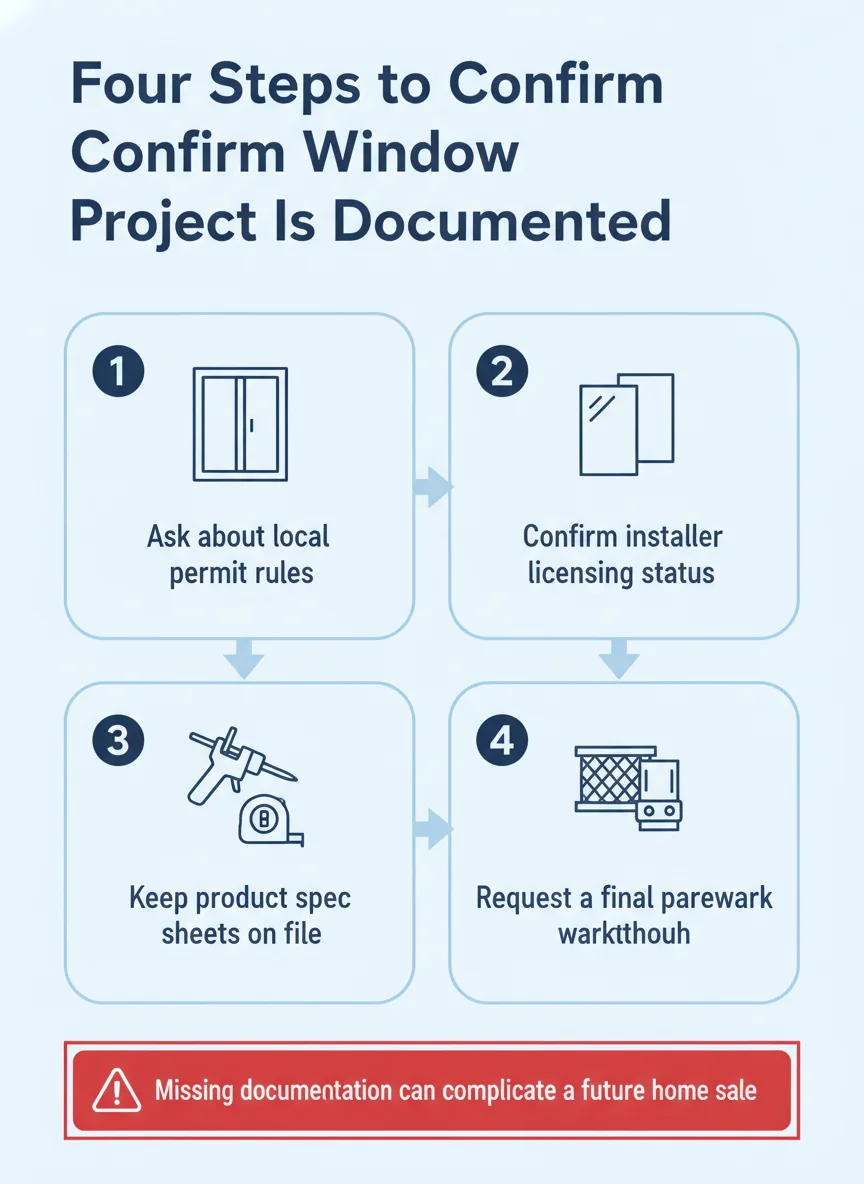
Step-by-step: Confirming Your Window Project Is Documented Correctly
A little bit of paperwork up front saves a lot of guesswork later, especially if you sell the house or file an insurance claim down the road. Here's the order most homeowners follow.
- Ask about permits: Before work starts, ask your installer whether your specific project requires a local permit and who is responsible for pulling it.
- Confirm licensing: Verify that the company doing the install carries whatever state or local licensing applies to exterior work in your area.
- Get a scope in writing: Have the installer put the scope of work, window count, and materials in writing before the job begins.
- Keep product sheets: Hold onto the manufacturer spec sheets for the windows installed, since they're what a warranty claim refers back to.
- File permit paperwork: If a permit was pulled, keep the final sign-off paperwork with your other home records, not just in an email thread.
- Request a walkthrough: Ask for a final walkthrough where the installer points out what was done and confirms nothing was left incomplete.
What You'll Find When You Ask About Compliance
Different installers will answer the paperwork question differently, and the answer usually tells you something about how they run the rest of the job.
If Your Installer Mentions Permits
A company that brings up permits unprompted is usually one that's handled enough projects to know which jobs trigger them and which don't. That's a good sign, since it means they're thinking about your paperwork before you have to ask.
If a permit does apply to your project, ask who files it and when you'll get a copy of the final approval. That copy is the closest thing a Colorado project has to the FENSA certificate you may have read about.
If Your Installer Mentions Manufacturer Warranties
Window brands typically back their products with a manufacturer warranty, separate from whatever workmanship guarantee the installer offers. Ask for the specific terms in writing rather than a verbal summary, since that document is what you'll refer to if a seal fails or a frame warps years down the line.
A reputable installer keeps a copy of that paperwork on file for you as well, in case your own copy gets misplaced. It's worth asking the question outright rather than assuming it's automatic.
DIY vs Calling a Pro for Window Compliance
There's very little about compliance paperwork itself that a homeowner needs to hand off, since reading a permit requirement or filing a spec sheet is work anyone can do. Where it gets harder is knowing which local rule actually applies to your specific project, since that requires checking your jurisdiction's current adopted code rather than guessing from a national generalization.
A licensed installer who works regularly in your area has usually already answered that question dozens of times for other homeowners on the same street or in the same subdivision. That familiarity is worth something, especially if your project involves a structural change to the opening rather than a straight swap of an existing window.
The split, in practice, is that homeowners can and should keep their own copies of everything, while the installer is the one who should be telling you upfront what your jurisdiction requires before the first window comes out. If an installer can't answer that question clearly, that's worth noting before you sign anything, and it's a topic covered in more depth in what to know before installing replacement windows in Colorado.
Getting It Right the First Time
FENSA was never going to show up on a Colorado project, but that doesn't mean the paperwork question disappears. It just points you toward the documents that actually matter here: permit records where they apply, product spec sheets, and a clear written scope of work.
If you're planning a window project anywhere in the Denver metro, including Englewood, ask about documentation before the job starts rather than after. Precise Windows LLC walks homeowners through that part of the process as a normal step in every project, not an afterthought.
Frequently asked questions
What is a FENSA certificate?
FENSA is a competent persons scheme used in England and Wales to confirm that replacement windows and doors meet building regulations there. It's a UK-specific compliance document and has no equivalent requirement in United States window projects.
Do I need a FENSA certificate for windows in Colorado?
No, FENSA does not apply outside the United Kingdom, so a Colorado homeowner will never be asked for one. What local jurisdictions typically want instead is proof that the work followed applicable building code and, where required, that a permit was pulled.
What should I ask for instead of a FENSA certificate?
Ask your installer for product documentation, any permit paperwork the project required, and a written note of the work performed. That combination is what shows up in a title search or appraisal review down the road.
Does a lack of FENSA paperwork affect selling my house in Colorado?
It won't, since FENSA was never part of the transaction here in the first place. What can affect a sale is missing permit records for work that did require one, so it's worth keeping whatever documentation your project generated.
How do I know if my window installer is reputable without a UK-style scheme?
Look at how they handle licensing, manufacturer warranties, and whether they're upfront about what paperwork your specific project needs. A company that explains the process clearly before the job starts is usually the one that handles it correctly after.