
Why This Question Comes Up So Often in the Denver Metro
Homeowners across the Denver Metro, from Englewood to Aurora to Lakewood, usually start asking this question after a cold snap or a string of hot days makes the house feel uneven room to room. One window might be fine while three others in the same house let in a draft you can feel standing nearby. That unevenness is what pushes the question from 'should I fix this one window' to 'should I just do the whole house.'
The honest answer is that it depends on how many windows are actually struggling and how old the house is. A house built in the same decade usually has windows that age at roughly the same rate, so if two or three are failing, more are likely close behind. Homes with additions or past partial updates often have a real mix of ages, which changes the math toward doing the worst rooms first instead of the whole house in one pass.
What Actually Drives the Value of Doing It All at Once
The case for whole-house replacement rests on a few practical things: one mobilization instead of several, one consistent look and performance level across every room, and one warranty period instead of staggered ones. Those are logistics and consistency benefits more than pure dollar savings, and they matter most to people planning to stay in the house for years.
Consistency in Comfort and Appearance
When every window in the house is the same age and material, the home feels even. No single room runs cold in January while the rest stay comfortable. From the street, matched frames and consistent glass also read as a cared-for home, which matters if you're thinking about resale even a few years out.
Mismatched windows, by contrast, create a visible patchwork that's hard to unsee once you notice it: a newer vinyl frame next to an older wood one, or a slightly different white tone between the two. It's a cosmetic issue more than a functional one, but it's one of the more common regrets homeowners mention after doing a partial job.
Project Logistics and Disruption
Doing all the windows in one project means one round of measuring, one install crew on site, and one stretch of plastic sheeting and open walls rather than repeating that disruption two or three times over several years. For a household with young kids, pets, or a home office, fewer total disruptions can be worth more than the math on paper suggests.
The flip side is that a whole-house project is a bigger single commitment, both in scheduling and in the size of the job. If the budget only supports a few windows right now, phasing in the worst ones first and finishing the rest later is a completely reasonable path, and it's one our team at Precise Windows LLC walks homeowners through regularly.
| Factor | Whole-house replacement | Phased replacement |
|---|---|---|
| Disruption | One project, one timeline | Repeated over multiple visits |
| Consistency | Matched style and performance | Mix of old and new until finished |
| Upfront commitment | Larger single decision | Smaller decisions spread out |
| Best fit for | Houses with uniform window age | Houses with a few clear problem windows |
What's Actually Behind the Glass and Frame
Every window is really two systems working together: the frame, which handles the structural seal to the house, and the glass unit, which handles insulation and light. Window Replacement covers both, in styles like double-hung, casement, sliding, bay and bow, picture, awning, and specialty shapes, measured at the house and installed so the opening seals tight rather than just dropped into the existing frame.
Over time, both parts age differently. Frames can warp, stick, or let air through at the weatherstripping long before the glass itself fails. Glass units, especially older double panes, tend to fail at the seal between the two panes, which is what causes the cloudy or foggy look you sometimes see on an otherwise solid-looking window. Knowing which part is failing in your house is part of why a measurement visit matters before deciding between repair and replacement.
Step-by-Step: How to Decide What Your House Actually Needs
Before committing to a whole-house project or a phased one, walk the house room by room with this process.
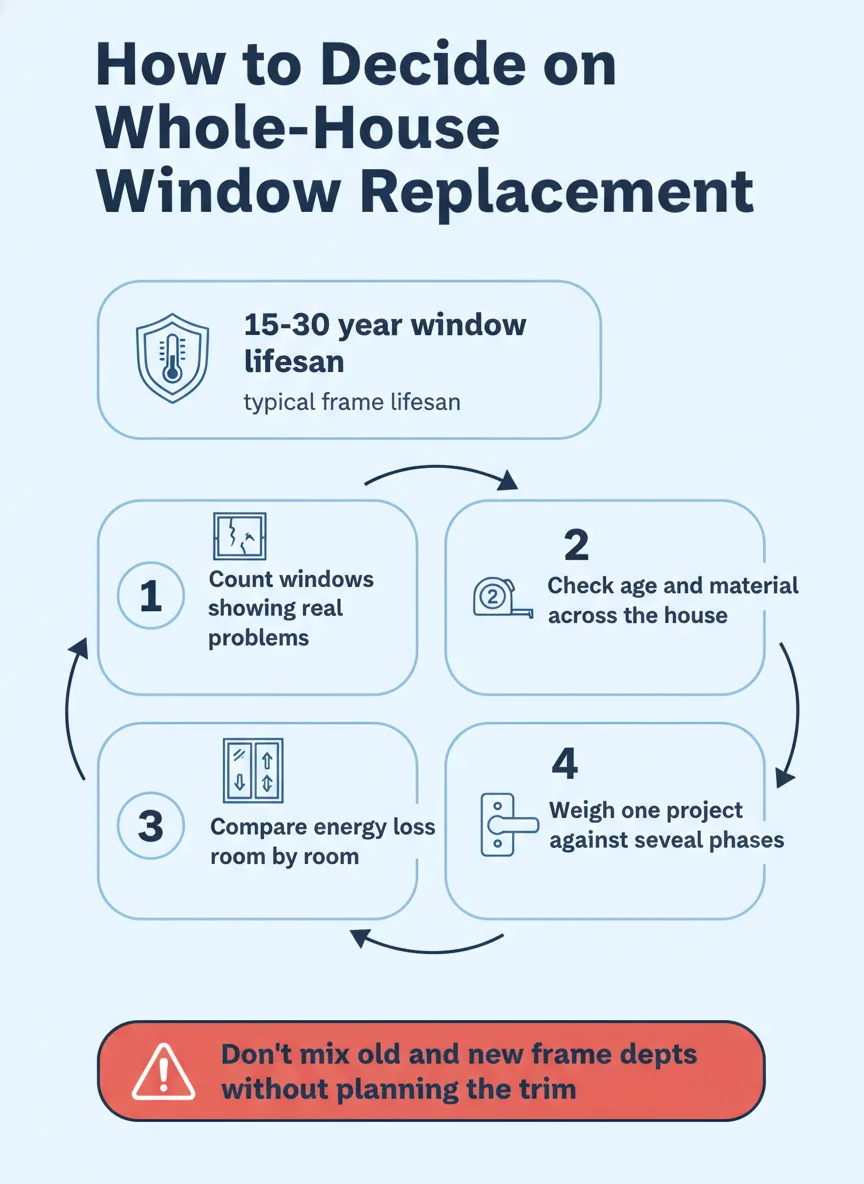
- List every window: Go room by room and note the age, material, and how each one feels to open, close, and lock.
- Flag the obvious problems: Mark any window with fog between the panes, a stuck sash, visible rot, or a draft you can feel standing near it.
- Group by age and material: Windows installed in the same era usually share the same weak points, so group them to spot patterns.
- Compare room comfort: Note which rooms run noticeably colder or hotter than the rest of the house during extreme weather.
- Get a measurement visit: A free inspection at the house will tell you which windows are structurally sound and which ones are past the point of repair.
- Decide on scope: Use the pattern from the walk-through to choose between a full-house project or starting with the worst rooms.
What You'll Typically Find Once You Look Closely
Most houses fall into one of two patterns once you actually walk through and check each window. The first is a house where every window is roughly the same age, installed when the home was built or during one past renovation, and most of them show the same wear at the same time.
The Uniform-Age House
If the house was built in one era and never had a partial window update, you'll usually find similar problems across most of the windows: the same style of weatherstripping failing, the same glass seals aging out around the same time. This is the clearest case for a whole-house project, since fixing a few now just means doing the rest again in a year or two.
In these houses, storm and hail damage can also accelerate the timeline if a recent weather event hit several windows at once, since insurance documentation often covers multiple openings in a single claim rather than one at a time.
The Mixed-Age House
Houses with additions, past partial remodels, or a previous owner who replaced a few windows will show a real mix: some openings are fine for another decade, others are failing now. This is the pattern that usually points toward phasing, prioritizing the rooms with the worst comfort or visible damage and planning the rest for later.
If you're not sure which category your house falls into, that's exactly what a measurement and inspection visit sorts out, by checking frame condition and seal integrity window by window rather than guessing from the outside.
What You Can Check Yourself vs. What Needs a Pro
Homeowners can do the first-pass evaluation themselves: checking each window for drafts, fog, sticking, and visible rot, and noting the age and style of each. This is useful information to bring into any conversation about scope, and it costs nothing but a walk through the house.
What a homeowner generally can't assess alone is the structural condition behind the trim, whether the opening itself has settled or shifted, and whether the existing frame depth matches what's available in the style you want. That's a job for a licensed installer who can measure the actual opening and flag anything that needs extra attention before the order goes in.
The actual installation, sealing the opening so it performs the way it's supposed to, is also squarely a professional job. A poorly sealed window can undo most of the benefit of upgrading in the first place, regardless of how good the window itself is.
Making the Call for Your House
There's no universal right answer between doing the whole house at once or phasing it room by room. It comes down to how uniform the wear is across your windows, how much disruption you're willing to take on at once, and how the budget lines up with the priority rooms. A walk-through and an honest look at each window will tell you more than any general rule.
If you're trying to figure out which path makes sense for your specific house, a free inspection is the fastest way to get a clear answer instead of guessing, and Precise Windows LLC handles that evaluation for homes across the Denver Metro.
Frequently asked questions
Is it better to replace all windows at once or one at a time?
It depends on your budget and how uneven the wear is across the house. Replacing all at once usually means one disruption, one crew mobilization, and matching style and performance across every opening, while phasing spreads the cost out but can leave mismatched windows for years.
How do I know if my windows are worth replacing?
Start with how they feel in use: are they hard to open, drafty near the frame, or fogged between the panes? If more than a few windows show these signs, or the frames are original to an older house, a full evaluation usually makes more sense than patching each one as it fails.
Does replacing all the windows increase home value?
New windows are generally viewed as a solid improvement by buyers and appraisers because they signal less deferred maintenance and better energy performance. The value impact is usually stronger when the whole house is done consistently rather than a patchwork of old and new.
Can I replace just some windows now and the rest later?
Yes, phasing is common and lets you prioritize the worst rooms first, such as north-facing bedrooms or windows with visible fogging. The tradeoff is scheduling more than one install and possibly paying for more than one site visit over time.
What's the difference between repairing and replacing a whole house of windows?
Repair fixes a specific problem like a broken seal or a stuck sash on an otherwise sound window, while whole-house replacement swaps the unit and often the frame throughout the home. Replacement makes more sense when multiple windows share the same age-related issues.