
Why Window Costs Vary So Much Across the Denver Metro
Ask five homeowners in the Denver Metro what they paid for new windows and you'll get five different answers, and that's normal. A window quote isn't one price, it's a bundle of choices stacked on top of each other: frame material, glass package, window style, how many openings, and how much work each opening needs before a new unit can go in. Two houses on the same street can end up with very different totals even though both just wanted "new windows."
That variation is exactly why it's worth understanding what goes into a quote before you start collecting them. Colorado's swing between summer sun and winter cold means glass performance matters more here than in a mild climate, and that performance isn't free. Once you know which factors move the number up or down, you can look at a bid and tell whether it reflects real value or just a low number designed to win the job.
What Actually Drives the Price Tag
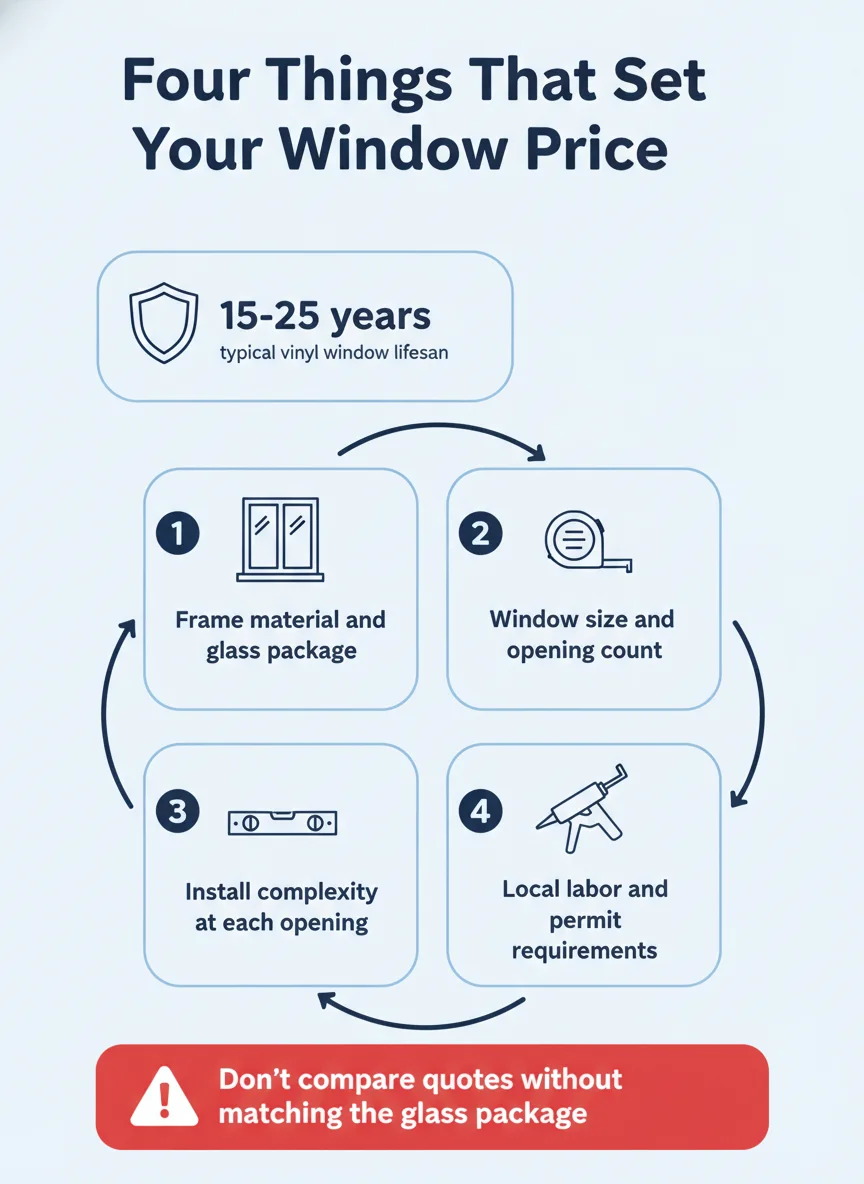
Four things do most of the work in setting a window price: the frame material, the glass package, the size and style of each opening, and how much extra labor the install requires. Everything else, including brand name and company reputation, tends to be a smaller factor than people expect.
Frame Material and Glass Package
Vinyl frames remain the most common choice for replacement windows because they balance cost, durability, and low maintenance, while wood and composite frames carry a higher price for a different look or feel. Within any frame material, the glass package you choose, single-pane versus double-pane, standard versus low-E coated, argon-filled versus not, moves the price meaningfully on its own.
For Colorado's temperature swings, most homeowners land on double-pane glass with a low-E coating, since it cuts down on both summer heat gain and winter heat loss. That coating and the gas fill between panes add cost per window, but they're also the piece most responsible for a lower energy bill over the life of the window, so it's worth weighing against the sticker price rather than against it.
Size, Style, and Install Complexity
A standard double-hung window in an average size install is the baseline most quotes are built around. Bay and bow windows, large sliding units, and oversized picture windows cost more because they need more glass, heavier framing, and sometimes a two-person crew to set in place safely.
Install complexity is the factor homeowners underestimate most. An insert replacement, where the new window goes into an existing, sound frame, is a simpler and faster job than a full-frame replacement, which is needed when the existing frame is damaged, out of square, or being changed in size. A home with several full-frame replacements will price higher than one needing straightforward inserts, even with identical windows ordered.
| Window Tier | What You Get | Best Fit For |
|---|---|---|
| Entry-level | Vinyl frame, standard double-pane glass, insert install where the opening allows | Budget-driven projects, sound existing frames |
| Mid-range | Vinyl or composite frame, low-E double-pane glass, argon fill | Most Colorado homes balancing comfort and cost |
| Premium | Wood or high-end composite frame, upgraded glass package, full-frame install where needed | Older homes with damaged frames, high-visibility openings |
The Parts of a Window Quote You're Actually Paying For
A fair quote breaks down into a handful of real cost centers: the window unit itself, removal and disposal of the old one, labor to set and seal the new unit, trim and finish work to make the opening look right, and any extra framing if the opening isn't straightforward. When a quote is vague about which of those it covers, that's the first thing to ask about before comparing numbers.
Sealing the opening properly is worth paying attention to specifically, since a window that's installed but not sealed tight will leak air no matter how good the glass is. Window Replacement done right means the opening gets measured at the house, not estimated from a floor plan, and sealed so the window actually performs the way its glass package promises.
Step-by-step: How to Get an Accurate Window Quote
Getting a number you can trust takes a bit more than one phone call. Here's the order that produces a quote worth comparing against others.
- List every opening: Walk the house and note each window you want replaced, along with its approximate size and current condition.
- Note visible problems: Write down drafts, fogged glass, sticking sashes, or frame rot you can see, since these flag openings that may need full-frame work.
- Request an in-home measure: A quote based on exact measurements at the house, not guesses, is the only kind that holds up once work starts.
- Ask for the glass package spelled out: Get the specific glass type and coating in writing so you can compare apples to apples across bids.
- Confirm insert vs full-frame: Ask which openings are quoted as inserts and which need full-frame replacement, since that split drives a lot of the total.
- Check what's included after install: Confirm whether trim, caulking, and cleanup are part of the price or billed separately.
- Compare scope before total: Line up what each bid actually includes before you look at the bottom-line number.
What a Quote Should Tell You
Reading the Line Items
A detailed quote should separate the window unit cost from labor, note the glass package by name, and specify insert versus full-frame for each opening. If a quote lumps everything into one number with no breakdown, you have no way to tell whether a lower total means a better deal or a thinner scope.
It should also state what happens to the old windows and frames, since disposal is part of the job even if it's easy to overlook. A quote that's clear on all of this makes it much easier to compare against a second or third bid without guessing at what's actually being promised.
Red Flags in a Low Bid
A number that's noticeably lower than every other quote you've gotten usually means something's been left out or downgraded, not that you found a deal. Common culprits are a thinner glass package than the others quoted, insert installs priced where full-frame work is really needed, or no workmanship warranty backing the labor.
The fix is simple: ask the lower bidder to match the exact scope of the higher quotes, including glass package and install type, and see what the number becomes. If it jumps to match the others, you've learned something useful. If the company won't put the scope in writing at all, that's worth noting too.
DIY vs Calling a Pro
Measuring your own openings, researching glass packages, and getting a feel for your budget before calling anyone are all things a homeowner can do without help. That groundwork actually makes the quote process faster, since you'll know what questions to ask and what you're hoping to get out of the project.
Actually setting a window in an opening, sealing it, and finishing the trim is a job for a licensed installer, especially for full-frame replacements where the structural opening itself is being touched. A window that's sealed wrong will let in drafts and moisture no matter how good the unit is, and that's not something to find out after the crew has left.
If you're weighing whether an opening even needs full replacement or could be patched instead, it's worth reading up on the difference first. Is It Better to Repair or Replace Windows? walks through how to tell which situation you're in before you request a quote at all.
Getting a Number You Can Actually Trust
The goal isn't finding the lowest quote, it's finding the one where the price matches the scope and the scope matches what your house actually needs. That means getting an in-home measure, asking for the glass package and install type in writing, and comparing bids line by line instead of total to total. Homeowners in Littleton and across the rest of the Denver Metro run into the same wide range of quotes, and the ones who end up satisfied are usually the ones who asked these questions before signing anything.
Once you've got a quote you understand, the rest of the decision gets a lot simpler. Precise Windows LLC measures each opening at the house and lays out the glass package and install type before any work starts, so the number on the page matches the windows that actually go in.
Frequently asked questions
What makes one window quote higher than another for the same house?
The gap almost always comes down to frame material, glass package, and how many openings need extra framing work, not just markup. A quote with double-pane low-E glass and a full frame replacement at a tricky opening will run higher than one quoting single-pane glass and a simple insert, even for the same window count.
Is it cheaper to replace all the windows in a house at once?
Doing the whole house in one visit usually costs less per window than tackling openings one at a time over several years, since labor and setup get spread across more units. It also means one disruption to the household instead of several separate ones.
Do bigger windows always cost more to replace?
Larger openings generally do cost more because they need more glass, a sturdier frame, and sometimes two installers instead of one. A picture window or a large sliding unit will run higher than a standard double-hung of average size.
Should I pick the cheapest window quote I get?
Not without checking what's actually included, because the lowest number sometimes means a thinner glass package, a shorter or no workmanship warranty, or an insert install where a full-frame replacement is really needed. Compare the scope line by line before you compare the total.
Does the window brand change the price a lot?
Brand plays a role, but the bigger swing usually comes from the glass package and frame material chosen within that brand's lineup, not the name on the sticker. Two windows from the same manufacturer can price very differently depending on the options selected.