
Why Mobile Home Windows Are a Different Project Across the Denver Metro
Mobile and manufactured homes sit all over the Denver Metro, from older single-wide units outside the city to newer double-wides on the edges of towns like Aurora and Arvada. These homes go through the same temperature swings as any other house here, 90 degree summer afternoons followed by nights in the 50s, and winters that drop well below freezing. A window that doesn't seal tight in that kind of swing shows up fast as a draft near the sill or frost forming on the inside of the glass.
The catch is that a mobile home window opening isn't built the same way as an opening in a stick-framed house. The wall is thinner, the framing lighter, and a lot of older units used aluminum-framed windows that were never great insulators to begin with. Replacing one of these windows with the wrong product, or one sized for a standard house, can leave gaps that no amount of caulk will fully close.
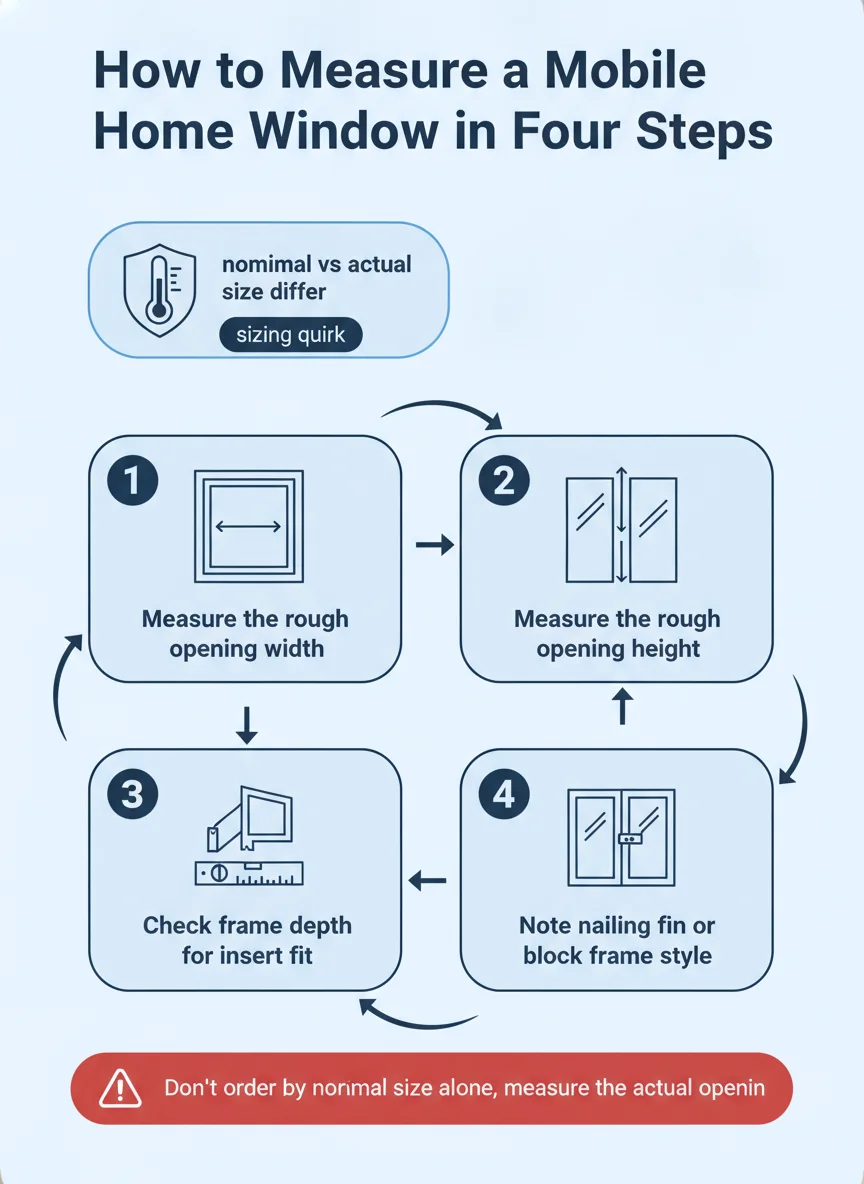
Why Mobile Home Window Openings Measure Differently Than You'd Expect
The short answer is that manufactured housing uses its own sizing convention, and it doesn't always match what you'd find at a big box store for a site-built home. A window listed as a certain nominal size can be a few inches smaller than the actual rough opening in the wall, which is the single biggest reason first-time buyers end up with a window that doesn't fit.
Frame Depth and Nominal Sizing
Mobile home manufacturers historically used a nominal sizing system where the number on the box refers to a slightly larger dimension than the glass and sash themselves. That means a window labeled for a certain opening might leave you with gaps on all four sides if you don't account for the difference. The fix is simple but easy to skip: measure the actual rough opening, not just the old window's label, before you order anything.
Frame depth is the other variable that trips people up. Mobile home walls are often shallower than a standard 2x4 or 2x6 wall, so a window built for a site-built house may stick out past the interior wall surface or sit too far recessed on the exterior. An install we handle for mobile and manufactured frames accounts for that depth difference up front instead of forcing a fit after the fact.
Air Sealing in a Lightweight Structure
A mobile home's exterior wall doesn't have the same mass or structural redundancy as a stick-built house, which means any gap around a window opening has a more direct path to the living space. That's part of why older single-wides with original aluminum windows can feel drafty even when the glass itself looks fine, the air is getting in around the frame, not through the pane.
Good air sealing on a mobile home replacement comes down to the same basics as any other house: a continuous bead of sealant, backer rod in larger gaps, and a window that's actually shimmed level and plumb in the opening. Skipping any of those steps on a lightweight wall shows up faster than it would on a thicker, more forgiving stick-built wall.
| Window Type | Best Fit For | Watch For |
|---|---|---|
| Vinyl single-hung | Standard mobile home openings with a shallow frame depth | Confirm frame depth matches the wall before ordering |
| Vinyl slider | Wider openings, common on living room walls | Track alignment matters more on a lightweight frame |
| Aluminum replacement | Matching an original look on an older unit | Conducts cold more than vinyl, can frost in deep winter |
| Vinyl awning | Smaller bathroom or kitchen openings that need ventilation | Hardware quality varies more than on larger window styles |
What's Actually Inside a Mobile Home Window Opening
Underneath the trim, a mobile home window opening is usually built around a metal or wood sub-frame that was set in place at the factory when the home was built. That sub-frame is what the window's nailing fin or mounting flange attaches to, and it's a different setup than the rough-sawn lumber framing you'd find in a site-built wall.
Because that sub-frame was installed once, at the factory, it can shift slightly over decades as the home settles on its foundation or piers. That's one reason an opening that was square when the home was new might be slightly out of square now, and it's why measuring the current opening matters more than trusting the home's original paperwork.
Step-by-Step: Replacing a Window in a Mobile or Manufactured Home
The process follows the same general order as a standard window replacement, with extra attention paid to the opening's actual dimensions and the wall's frame depth at each step.
- Measure the opening: Measure width and height at multiple points, since mobile home openings can be slightly out of square after years of settling.
- Check frame depth: Confirm how deep the wall cavity is so the replacement window sits flush inside and out rather than proud or recessed.
- Remove the old window: Take out the existing unit carefully to avoid damaging the siding or the factory sub-frame it's mounted to.
- Inspect the sub-frame: Check for rot, rust, or movement in the frame the new window will attach to before setting anything in place.
- Set and shim the window: Level and plumb the new unit in the opening, shimming as needed so it operates smoothly once fastened.
- Seal the perimeter: Apply sealant around the full frame on both the interior and exterior to close any gap between window and wall.
- Finish the trim: Reinstall or replace interior and exterior trim to cover the fastening points and give the opening a finished look.
What to Look For When Diagnosing an Old Mobile Home Window
Most mobile home windows that need replacing announce themselves pretty clearly before you even get a measuring tape out. The question is usually whether what you're seeing is a frame problem, a glass problem, or both, because that changes what fixes the issue.
Signs the Frame Is the Problem
If a window is hard to slide, doesn't latch flush anymore, or has visible daylight around the edge of the frame, the problem is usually the frame or the seal around it rather than the glass itself. Aluminum frames in particular can warp slightly over years of temperature swings, which throws off how the sash tracks.
A frame that's pulling away from the siding, or trim that's cracked and separating, is also a frame-level issue. These symptoms mean the fix is a new window and frame assembly, not just new glass dropped into the old one.
Signs the Glass Itself Has Failed
Fogging or a hazy film between two panes of glass means the seal on a double-pane unit has broken and moisture has gotten between the layers. This is a glass problem rather than a frame problem, and in some cases it can be addressed with a glass-only repair rather than a full window swap.
Cracked or chipped glass with an otherwise solid, square frame is another case where the frame may still have useful life left even though the glass needs attention. Worth a second look before assuming the whole window needs to come out.
DIY vs. Calling a Pro for a Mobile Home Window
A homeowner who's comfortable with basic tools can usually handle simple maintenance on a mobile home window, things like re-caulking a gap, tightening loose hardware, or replacing a torn screen. These are low-risk tasks that don't touch the structural opening and are forgiving if you make a small mistake.
Full window replacement is a different story, especially given how much mobile home openings vary in frame depth and sub-frame condition compared to a standard stick-built wall. Getting the measurements wrong, or missing rot in the sub-frame, can mean a window that never seals right no matter how much caulk gets applied afterward.
A licensed installer who has worked on manufactured housing before will know to check frame depth, inspect the sub-frame condition, and account for any settling in the opening before ordering a window. That upfront diligence is usually the difference between a window that lasts for years and one that needs attention again within a season.
Getting a Mobile Home Window Done Right
Mobile and manufactured homes aren't lesser projects, they just play by a different set of rules than a site-built house, from nominal sizing to shallower frame depth to a sub-frame that was only ever installed once at the factory. Understanding those differences before you buy a replacement window saves a round trip to the supplier and a second install visit.
If you're weighing options for a window in Englewood or anywhere else in the metro and want a second opinion on whether a repair or full replacement makes more sense, it helps to read up on how frame materials compare before deciding. Precise Windows LLC measures and installs replacement windows for a range of frame types across the Denver Metro.
Frequently asked questions
Can I put regular replacement windows in a mobile home?
Not usually without modification, because mobile and manufactured homes are built with lighter wall framing and different opening depths than a site-built house. Most mobile home window openings need a window made for that frame style, or a licensed installer who can adapt a standard unit to fit.
What size are mobile home replacement windows?
Mobile home windows are often sold by a nominal size that is a few inches smaller than the actual glass opening, which trips up a lot of first-time buyers. Always measure the rough opening yourself or have it measured before ordering.
Are vinyl windows good for a mobile home?
Vinyl is a common and practical choice for mobile and manufactured homes because it's lightweight, doesn't conduct cold the way aluminum does, and holds up well without repainting. The tradeoff is that vinyl frames are thicker, so they need to fit the opening correctly to seal well.
How do I know if my mobile home windows need to be replaced?
Signs include drafts you can feel near the frame, foggy glass between the panes, windows that are hard to slide or lock, and visible gaps between the frame and the wall. Any one of these usually means the seal or frame has failed and a new window will perform better than a repair.
Do mobile home windows need a special installer?
They don't always require a specialist, but the installer needs to understand the difference between a mobile home's lightweight frame construction and a standard stick-built wall. Getting the flashing and sealing right matters more on a mobile home because the wall assembly has less margin for error.